

Moose is a yellow Lab, ten years old, eighty-two pounds on the vet's scale. Around the time he turned eight he started doing a thing where he would lie on the hardwood for a while and then take a good three or four seconds to figure out how to get his back legs under him. No yelp. No limp. Just a delay, like a cold engine turning over in January. The vet looked at his hips, took a picture of them, said early arthritis, and told me two things: keep him lean and keep him moving. Then she said a joint supplement was reasonable if I wanted to try one, and the brand she named first was Nutramax Cosequin.
I am not a vet and I am not going to pretend to be one. I am a retired mechanic with a garage, a toolbox, and a dog. When something is broke I want to know what the part does before I bolt it on, so I read the bottle. This is what two years of daily use has looked like at my house, including the parts that did not go the way I hoped.
The Quick Verdict
Two years, one tablet split into breakfast, no drama. Moose gets off the floor faster than he did at eight, and that is the whole claim I am willing to make.
Amazon Check Today's Price →The supplement my vet named before I asked about supplements
One bottle is sixty tablets, chicken flavored, sized for a large dog. Moose has taken it every morning since his age-eight checkup. Read the label and ask your own vet about dosing for your dog's weight.
Amazon Check Today's Price on Amazon →How I've Used It
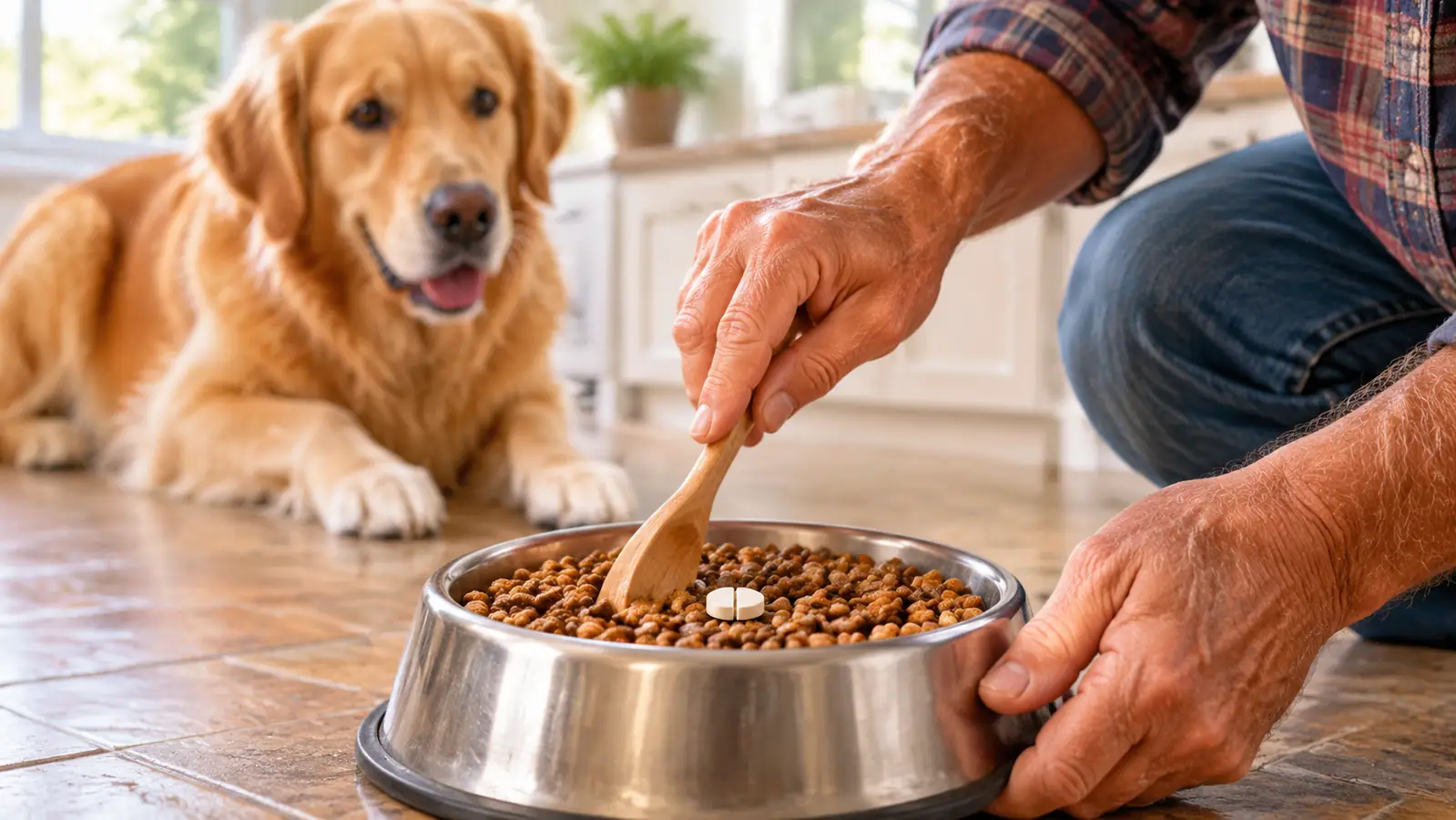
One tablet, every morning, since the vet's age-eight checkup. That puts us at about two years now. The tablet breaks in half cleanly enough, so I split it and stir both halves into his breakfast kibble with a splash of warm water. He does not pick it out and he does not walk away from the bowl, which is more than I can say for a couple of pills I have tried on him over the years. Chicken flavor probably does the heavy lifting there.
Before this, he was on nothing. No supplement, no chews, no powder. I had looked at a couple of tubs at the feed store a year earlier and put them back on the shelf, because the labels were a wall of numbers I could not read and the scoops were sized for dogs smaller than mine. What changed my mind was not a label. It was the vet saying the word arthritis out loud and then naming a bottle without being asked. I wrote it on the back of a receipt in the truck and drove to the store the same afternoon.
The routine matters more than people think. A supplement you give three days a week and forget about is not a fair test of anything. I keep the bottle on the same shelf as his food scoop so the two things are in the same motion at six in the morning. If you are the kind of person who will remember, fine. If you are not, put the bottle where the bowl is and stop relying on your memory.
The one thing I did not do is change the dose on my own. I asked the vet what was right for a dog his size and I followed the label from there. When his weight drifted up a couple of pounds one winter, I called and asked again. That is not a phone call you skip because you read something on a forum.
What Is Actually in the Bottle
The label lists glucosamine hydrochloride at 600 mg, sodium chondroitin sulfate at 300 mg, and methylsulfonylmethane, which everyone shortens to MSM. That is what is printed on the bottle, and that is all I am going to tell you it contains. Forty years of reading service manuals taught me the difference between what a part is rated for and what it actually does in your truck, and the same caution applies here.
The bottle itself is small. Five and a quarter inches tall, under three inches across, eight ounces on the shipping scale, so it sits on a shelf next to a food scoop without taking over the space. What I checked first was the tablet count, because a tablet I cannot break is a tablet I have to fight a dog over. What I checked second was the ingredient list, printed in actual milligrams rather than folded into a blend, since a blend is the trick that makes a label impossible to compare against anything else on the same shelf.
The plain-English version, as I understand it and as my vet explained it to me: glucosamine and chondroitin are building-block type ingredients aimed at the cartilage in a joint, and MSM gets grouped in with them. That is the theory. I am not qualified to say what happens at the cellular level and neither is any review on the internet, including this one. What I can tell you is that the product carries a large-breed label, it is a tablet and not a soft chew, and the bottle holds sixty of them.
Nutramax is not a fly-by-night outfit. The label says the company has been at pet health for over twenty five years, and the same bottle says it is the top vet recommended retail joint supplement brand. Take the marketing language for what it is worth. What got my attention was simpler: the vet named it without me bringing it up, and she had no reason to push a specific bottle at me.
What Changed, and Roughly When
Nothing happened for the first two weeks. I want that on the record because I have read plenty of reviews where the dog was doing backflips by Tuesday. The first six weeks looked exactly like the six weeks before them. Same slow stand, same hesitation at the two back-porch steps, same routine.
Somewhere around week six or seven I noticed I was not waiting on him anymore. He would get up off the floor and be walking while I was still reaching for my coffee. It was not a jump in ability, it was a shortening of that delay. Where he used to take three or four seconds to gather his back legs, he started taking one or two. By the three month mark it was consistent enough that my neighbor asked what I had changed.
I mark things on a calendar in the garage because I forget them otherwise. The note for the first week of tablets says no change at all. The note for week nine says he was up on his own before I got the coffee poured, and I remember writing that one because it was a Tuesday and I had the truck half loaded for a dump run. That is the kind of evidence you get with a supplement. Not a lab result, just a line on a calendar that says this morning went differently than the last hundred did.
Here is the honest part, and it is why I score this a strong four and a half instead of a perfect number. The vet also told me to get weight off him and keep him moving, and I did both of those things in the same stretch of time. Moose dropped a few pounds and we started walking the same loop every morning. I cannot slice the credit cleanly between the tablet, the weight, and the walking. What I can tell you is that we held all three steady for two years, and he is more comfortable at ten than he was at eight.
What It Does Not Do
It does not get him up the two steps to the back porch on a cold morning. It does not put him in the bed of my pickup. It does not keep his feet from sliding out from under him on the tile when he turns too fast. A joint supplement is not a piece of hardware and it will not do the job of one.
On bad mornings, the porch steps still get handled by hand. I steady his back end and we go down slow. For the truck, I set a folding ramp against the rear cab door and he walks up it, and that has been true since before I started the tablets. Inside the house, the slick floors are still slick, so the evenings are a traction problem and not a supplement problem. Different jobs, different tools.
And it is not a fix, it is a floor. He is ten and he has arthritis in those hips. Nothing in a bottle reverses that. If you are shopping for something that will make a ten-year-old dog into a five-year-old dog, you are going to be disappointed by this product and by every other one on the shelf.

The Daily Grind: Splitting, Storing, and Getting It Down
Sixty tablets is two months at one a day, so this is a recurring purchase and not a one-time repair. Set your expectations there. I buy two bottles at a time now so I am not caught short on a Sunday night with an empty bottle and a dog who is used to his routine.
The tablet itself is firm. If your dog inhales food, this is simple. If your dog is a sniffer and an inspector, break it and mix it in with something wet. On the two occasions Moose went off his food, I crushed a half between two spoons and stirred it into a little canned food, and he took it fine. The bottle lives in a dry cabinet, not the garage, because a garage in Sacramento gets hot and I am not interested in finding out what heat does to it.
I keep a small plastic scoop in the bottle, which is not necessary but saves me digging with my fingers. Both the bottle and the scoop live on the same shelf as the food, so grabbing them is one motion at six in the morning. The one time I got lazy and left the bottle out on the counter overnight, nothing came of it, but I moved it back anyway. Two years of this has taught me the routine is the product. A bottle in a cabinet you walk past every morning gets used. A bottle in a drawer does not.
The one real annoyance is the count. Sixty sounds generous until you are eight weeks in and counting tablets against the calendar. If your dog is on the bigger end of the large-breed label and your vet has you on more than one tablet, the bottle goes faster than you expect. Price it at today's price per tablet before you commit to a monthly habit, not a one-off purchase.
What I Liked
- Noticed easier, faster morning stands somewhere around week six to eight
- Tablet breaks cleanly in half and mixes into kibble without a fight
- Chicken flavor means my dog takes it without a pocket full of cheese
- The first brand my vet named, from a company that has been making it for decades
Where It Falls Short
- Two months per bottle, so it is a standing cost, not a one-time buy
- No visible change at all in the first few weeks, which is easy to quit through
- Does nothing for the porch steps, the truck, or slick tile floors
- A firm tablet, not a soft chew, so picky dogs may need it crushed
At eight he took three or four seconds to get his back legs under him. At ten he takes one, maybe two. That is not a cure. It is the difference between a dog who dreads the floor and a dog who does not think about it.
Who This Is For
This is for the owner of a large-breed dog who is starting to show that hesitation, the slow stand, the look at the stairs before he takes them, and who has already heard the word arthritis from a vet. It suits someone willing to run the experiment properly for two months before deciding. It also suits someone who already has the other pieces in place: a dog at a healthy weight, some daily movement, and a plan for the slippery floor and the vehicle.
If your dog is seven or eight and the vet has talked about joint support, this is the conversation I would have. Ask what dose fits your dog's weight, run it daily, and give it eight weeks before you form an opinion. Nutramax has been the brand on my shelf for two years and I have not had a reason to go looking for another one.
Who Should Skip It
Skip it if you want a fast result. Two months is the honest test window and the first few weeks look like nothing is happening. Skip it if your dog has a medical condition or is on other medication, because that is a question for your vet and not for a guy with a garage. Skip it if you are not going to give it every day.
And skip it if you think a tablet replaces the boring stuff. The weight, the walking, the ramp, the steadying hand on the back steps: those did as much for Moose as anything in the bottle. If you are looking for one purchase that makes the stairs stop being a problem, buy a ramp. If you are looking for daily joint support alongside a dog who is already being handled sensibly, this is the one I keep buying.
Two years in, and the bottle is still on the shelf by the food scoop
Sixty chicken-flavored tablets, sized for a large dog, breaking cleanly in half so you can split them into breakfast. Check the current price, then ask your vet about the right dose for your dog's weight before you start.
Amazon Check Today's Price on Amazon →