
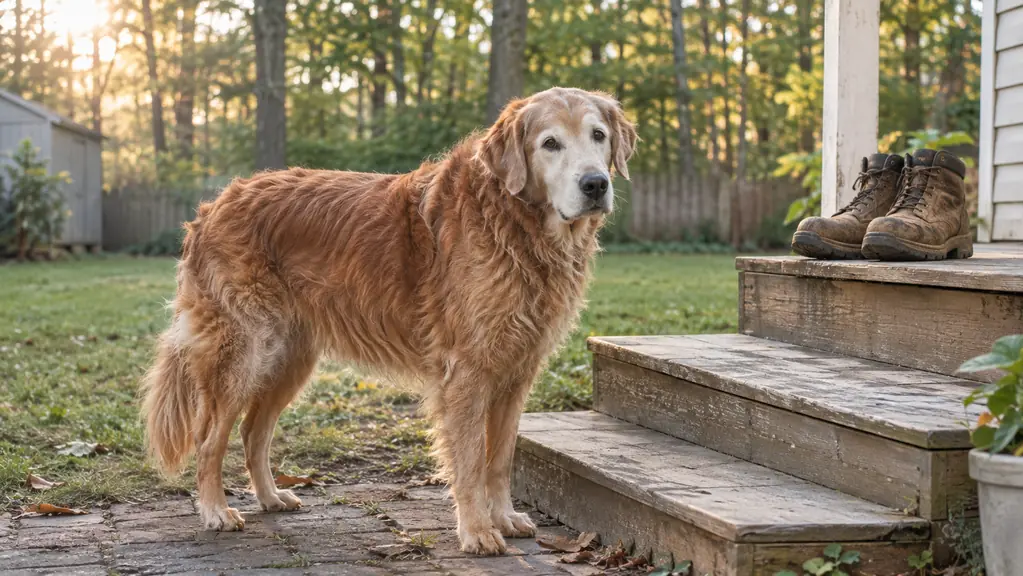
The two steps off my back porch are six inches apiece. That is the entire obstacle, and for the first eight years of Moose's life he cleared them without breaking stride. Then he started stopping at the bottom, front paws on the first board, back end planted in the grass, doing the arithmetic. Some mornings he would take them. Some mornings he would stand there for a count of ten and then turn around and go lie down.
I tried what everybody tries. I put a hand under his belly and walked him up, which worked fine until my own back started filing complaints, and until I noticed I was doing all the lifting and he was doing none of the work. I tried going up first and calling him. I thought about carrying him, and then thought about 82 pounds of yellow Labrador at chest height on a damp board, and let that idea go. What finally worked was a rear lift harness, the PICK FOR LIFE adjustable dog lift harness, plus a routine that took about two weeks to stop feeling clumsy. Here it is, in the order I would do it again if I had to start over.
The strap that turned two porch steps back into two porch steps
Moose is 10 and about 82 pounds, and on bad mornings this goes around his rear end before he touches the porch. Ten months in, it still hangs by the back door.
Amazon Check Today's Price on Amazon →Step 1: Get the Vet's Read on the Back End First
I am not a vet. I fix cars for a living and I read the label before I buy things, and that is the whole of my authority here. So the first move was having Moose looked at. That happened at his age-eight checkup, where the vet found early hip arthritis, told me to keep him lean and keep him moving, and put a name to the slow stand-up I had been watching for six months.
The reason this comes first is that not every wobbly back end is the same problem. A dog with a sore hip, a dog with a bad knee, a dog with nerve trouble down the hindquarters, and a dog who is simply carrying ten extra pounds can all look pretty similar from the porch. A lift harness helps with some of those and does nothing for others. The vet can tell you which one you are dealing with, and whether weight-bearing exercise on the steps is fine or whether he should be skipping them for a few weeks.
Ask the direct question: is it alright for him to keep climbing if I support his rear end? In Moose's case the answer was yes, keep him moving, help where he struggles, do not let him quit the stairs entirely. Muscle he does not use, he loses, and a dog who stops climbing stairs at ten is a dog who cannot climb stairs at eleven. That answer is what made the rest of this worth doing.
Step 2: Fit It on Flat Ground, Not at the Bottom of the Stairs
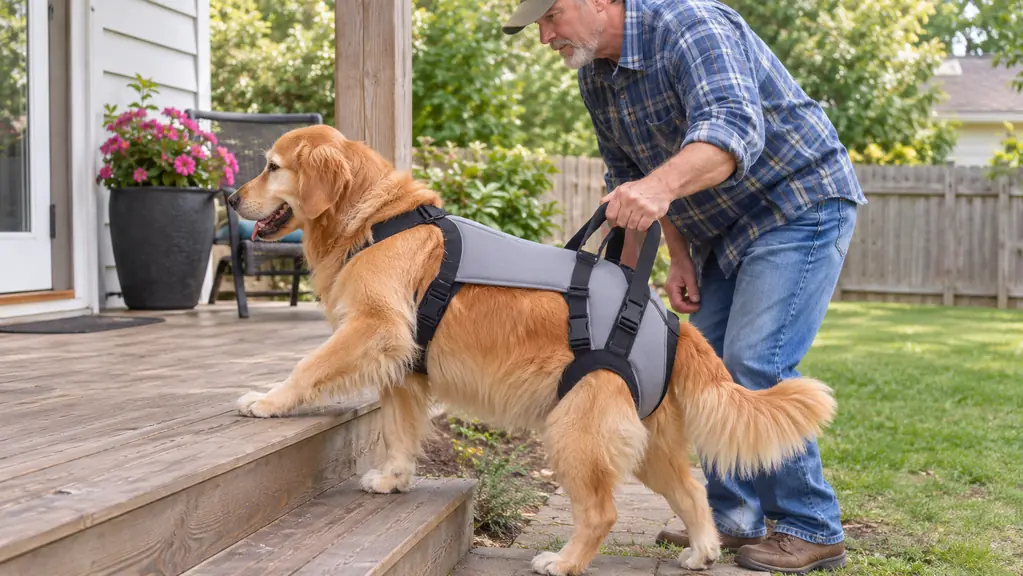
The first fitting happens in the kitchen or the garage, on level floor, with the dog standing square and not especially excited. The PICK FOR LIFE harness is an adjustable strap rig, sized X-Large, built for large to extra large dogs, and it goes around the rear end with a padded handle on top for your hand. It weighs about fourteen ounces, so it hangs on a hook by the door without complaint.
Snug is the whole game. You want it close enough that it does not slide around when you take up weight, and loose enough that you can still get two fingers under the strap without digging in. Walk him twenty feet on the flat and watch the back legs. If he hitches or bunches up, it is wrong, and it is usually wrong because the strap is sitting too far forward or too far back, not because the harness is bad.
Then take it off. Treat. Put it back on for thirty seconds. Treat. Do that three or four evenings running before you ever point him at a stair. The first time Moose wore his he stood in the kitchen looking at me like I had put a coat on him backwards, and if I had taken that straight out to the porch steps he would have learned that the harness means something unpleasant is about to happen.
Step 3: Practice Going Down Before Going Up
Most people start with the climb. I would start with the descent, because down is where a big dog scares himself. The front end goes first, the back end has to follow, and if the back legs give out the dog lands on his chin. That is the fall he remembers, and it is the one that makes him quit the stairs.
Stand on the lower side, below the step, with your hand on the handle. Let him set the pace. Take weight only when he commits and you feel him hesitate, and then take a little, not all of it. What you are giving him is a handrail, not a crane.
Moose took maybe four sessions before down stopped being a negotiation. The first two he basically leaned on me the whole way. By the fourth he was taking the step himself and only using the handle for the last half second, which is exactly what you want. If your dog never gets past leaning, that is information, and it is worth a call to the vet.
Ten months in, the two back-porch steps are just steps again. Same dog, same boards, one strap and about four seconds of my hand.
Step 4: Run the Steps With Your Hand on the Handle
Position matters more than strength. Stand on his left, slightly behind and below him, handle in the near hand. Let him look at the step. Do not rush him into it, because a dog who gets hurried plants his front feet and then you are both stuck at the bottom of two six-inch boards having a standoff.
When he lifts the front end, take up the slack and let him feel you there. Not a hoist. You are not lifting 82 pounds, and if you are, you will know it in your shoulder by the second week. You are taking the hesitation out. His back feet should land on the tread under their own power while your hand does a fraction of the work. That is why the padded handle on the PICK FOR LIFE harness matters more than it sounds like it should, since a bare strap starts cutting into your fingers by the third morning and then you stop using it.
The tell that it is going right: one step at a time, both back feet landing flat, no scrambling. The tell that you are doing too much: his back feet swing forward without touching anything, or he surges because he feels the lift and tries to outrun it. Ease off. Two steps, then stop and let him stand at the top for a second. The pause is part of the training. It tells him the landing is a place where good things happen, not a place where he just survived something.
Step 5: Make the Rest of the Route Easier Than the Steps
The porch steps were never the whole problem. They were the visible part. Inside the house it is hardwood and tile, which for an older Lab is a skating rink, so Moose wears non-slip socks in the evenings and on cold mornings and gets them off before we go outside. In the living room corner there is a memory foam orthopedic bed, which handles the slow stiff stand after a nap. In the truck there is a folding ramp, kept in the garage and set against the rear cab door of the F-150 on every trip. That is the ramp's job, not the harness's job, and I have kept it that way because Moose knows what each piece of gear means.
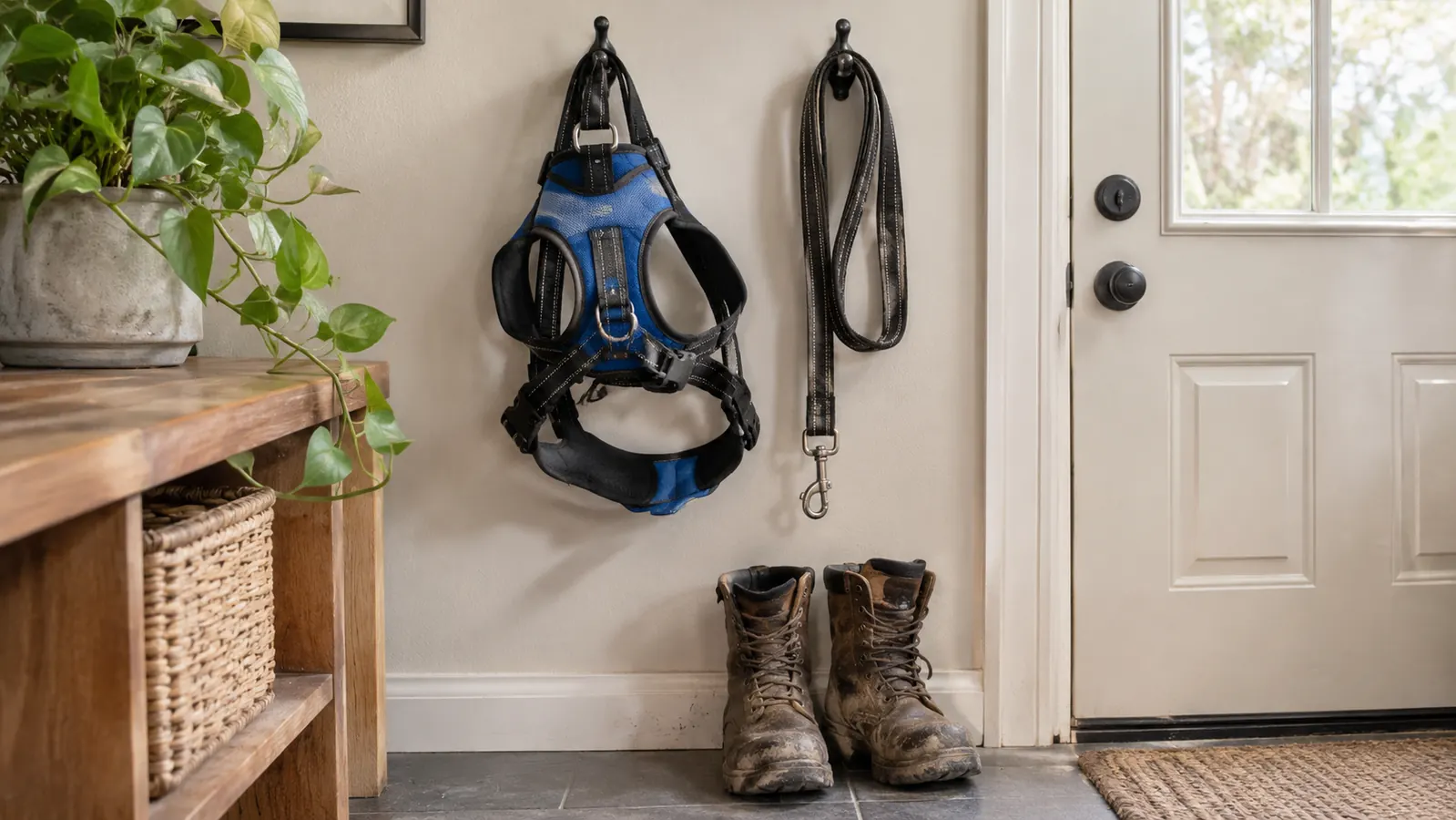
Two things matter more than any of the hardware. The first is weight. The vet said keep him lean and I have kept him lean, because ten pounds off a dog with sore hips is worth more than anything you can buy. The second is placement. The harness lives on a hook by the back door, not in a drawer, because the morning I have to go find it is the morning we skip it and he stands at the bottom of the steps doing the arithmetic again.
Check the strap every couple of weeks. It is nylon, it will get wet and muddy, and it is machine washable, so wash it. Two honest limitations worth knowing up front: the harness only helps the rear end, so if the front is the problem it will not do much for you, and the listing carries a seven-day warranty, which is short. I would rather you hear that from me now than find it out later.
What Else Helps
Daily joint support is its own lane. Moose has been on Cosequin chewables since that age-eight checkup, one tablet split into his breakfast, and I noticed easier morning starts somewhere around six to eight weeks in. Gradual. Nothing dramatic. It does not help him climb a step, but it seems to help him feel less like a rusted hinge when he first stands up, which makes everything after that easier, the stairs included.
Treats at the top of the stairs do more than people give them credit for. A dog who gets a piece of chicken every time he reaches the landing learns that the landing is a good place. Moose would climb those steps for a piece of chicken on a day he would not climb them for me. Use that instead of arguing with him, because you will lose that argument.
The bed and the socks and the ramp all stack. Rest on a bed that is not a flattened old cushion means he gets up with less of the slow stiff stand. Socks on the hardwood mean he is not bracing every time he crosses the kitchen, which saves the hips for the porch. The ramp means the truck is not a two-person lift anymore. None of them replaces the harness on the steps, and the harness does not replace any of them.
Keep the vet in the loop. The harness is a tool for a dog who is still moving. If your dog starts knuckling over, dragging a back foot, or refusing the steps entirely and not just on bad mornings, that is not a gear problem and no strap fixes it. That is a phone call, and sooner is better than later.
Ten months of bad mornings, one strap by the door
The PICK FOR LIFE lift harness is sized X-Large for large to extra large dogs, adjusts with a strap, and carries a padded handle for your hand. It is the tool that got Moose up the two steps and kept my back out of it.
Amazon Check Today's Price on Amazon →