
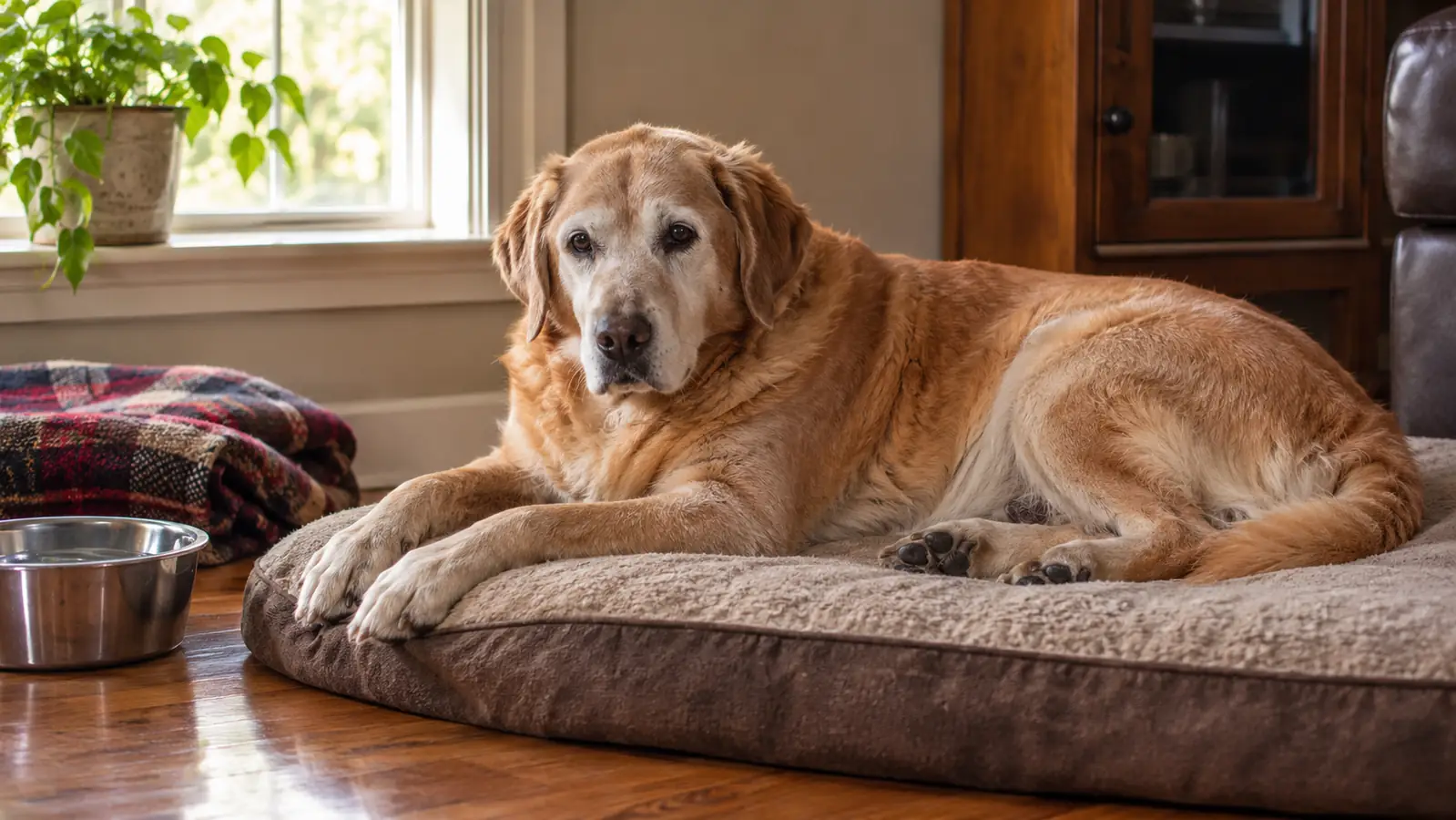
I did not set out to buy a dog bed. I set out to stop watching my Labrador fight his own back end. Moose is 10, about 82 pounds, and his hips went stiff around age 8. The vet looked at the x-rays at his checkup that year, called it early hip arthritis, and told me to keep him lean and keep him moving. Fine advice, and I have followed it. What nobody mentioned was that the getting-up part happens on whatever the dog has been lying on, and that a soft bed can make a stiff dog's morning harder instead of easier.
Here is the short version. For a big senior dog with sore hips, the JOYELF orthopedic bed is the better buy, and the gap is mostly in one place: what the dog has to push against when he stands. A standard dog bed is loose fill in a cover. Under 82 pounds it compacts, and after a while there is nothing left but a thin mat with a rim. The JOYELF bed is built on a solid memory foam base, 40.16 by 30.31 by 9.06 inches with a rated limit of 100 pounds, so Moose has a firm floor under him and a side wall to hook a front paw over while his back legs catch up. If your dog is three years old and sleeps on the tile half the time anyway, buy the standard bed and keep the difference. If your dog hesitates before he stands, the foam is the part you are paying for.
One clarification on the comparison. I have not bought a standard dog bed for Moose. What he had before was a flat old cushion that had gone to nothing, and I have handled the standard beds at my neighbor's place and read plenty of listings. So when I say standard bed I mean the common thing: a rectangular cover stuffed with loose polyester fiber, an inch or two of loft, no solid core, sold as plush and cozy. That is what most beds on the shelf are, and it is what the old cushion Moose slept on for years had amounted to by the end.
| JOYELF Orthopedic Bed | Standard Dog Bed | |
|---|---|---|
| Base and fill | Solid memory foam base with polyester fiber over the top | Loose polyester fiber fill in a cover, no solid core |
| Getting up from it | 9.06 inch side wall to hook a paw over, base holds its shape | Compacts into a thin mat, the dog rises off the floor |
| Holding shape under a big dog | High density memory foam, rated for dogs up to 100 pounds | Flattens in the spots where the dog lies |
| Washing | Cover zips off and goes in the machine | Varies by bed. Many are whole bed wash or spot clean only |
| Hair | Hair lifts off the cover | Hair works down into the fill |
| Moving it between rooms | 9.79 pounds and a 40.16 by 30.31 inch footprint, it stays where it lands | Light enough to drag with one hand |
| Tight spaces and crates | Needs the full 40.16 by 30.31 inch footprint plus room to get in | Thin and flexible, tucks into a corner or a crate |
| A dog that cannot step over a wall | Has sides, and a weak dog may need a hand getting in | Nothing to step over |
| Best for | A large or senior dog that needs support rising | A young dog with sound hips |
Where JOYELF Wins
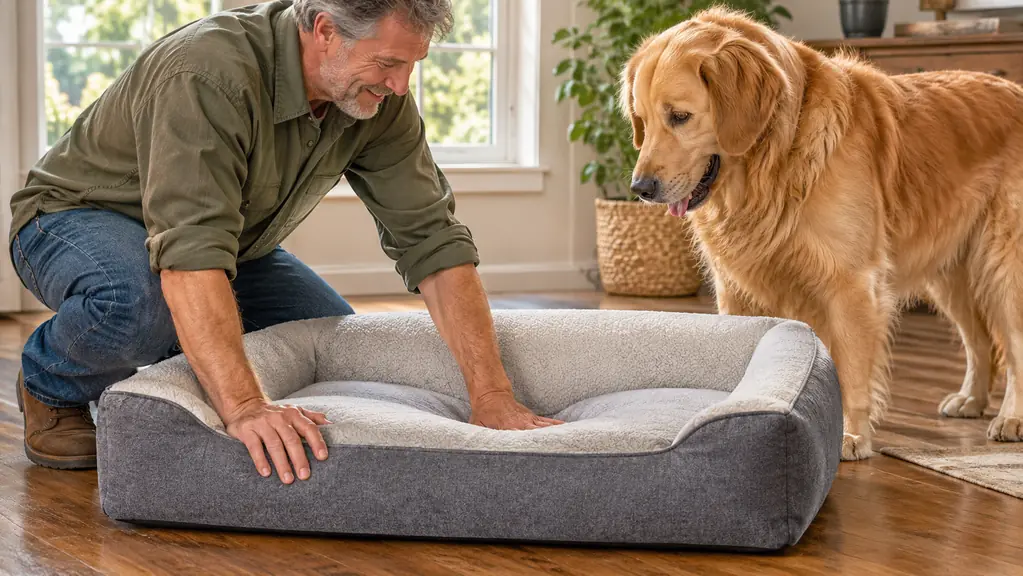
Start with the base, because that is the whole argument. The listing calls it a solid memory foam base, with polyester fiber over the top, and the bed is rated for dogs up to 100 pounds. Moose is 82, so he sits inside that number with room to spare. What it means in the living room is that he does not bottom out. He sinks a little, the foam spreads the load, and when he shifts his weight forward to get up, the base pushes back against him. Fourteen months of daily use in, the spot where he sleeps is still a spot, not a dent.
Second is the side wall. Nine inches is enough for Moose to hook a front paw over the edge and pull himself upright in stages, which is exactly how a dog with bad hips does it. He stands in three moves, not one. On a flat bed there is no edge to hook, so the whole job happens on the floor with a blanket tangled around his feet. Back in January we had a cold snap and Moose was stiffer than usual, so I timed him one morning out of plain curiosity. Forty seconds from lying down to standing, in three separate pushes. On the old cushion the same sequence took closer to two minutes, and once he stopped halfway through it and lay back down. Same dog, same hips, same cold morning.
Third is upkeep, which matters more than people expect with a big shedding dog. The cover zips off and goes in the machine. Hair lifts off the fabric with a rubber glove instead of working down into the fill. The old cushion could not be washed at all, so it got aired on the porch and still smelled like a dog by August. The bed ships with a squeaker toy in the box. Moose gutted it in a day, because he guts everything, but that says more about Moose than about the toy.
Where a Standard Dog Bed Wins
I am not going to tell you the foam bed wins everywhere, because it does not. A standard bed is lighter and easier to move. This one stays in the living room corner because shifting 9.79 pounds of foam with a 40 inch footprint around a house is work, and I am not going to do work I do not have to. A standard bed you can grab by one corner and drag out to the garage or into the truck.
It also fits places the big bed will not. A tight corner, a back seat, a crate beside the desk. The JOYELF needs the full footprint and a little elbow room to get in and out of. My neighbor's bed folds in half when I pick it up, which is not a compliment about support, but it is a compliment about storage.
And there is a real case for a low flat bed if your dog has gotten to the point where he cannot step over a nine inch wall at all. The neighbor's dog is a nine year old mix, maybe 55 pounds, and he has slept on a standard bed for two years. I picked that bed up off the floor and it came up like a wet blanket, no resistance in it at all. That is not a knock on the neighbor. It is what loose fill does over time, and it is worth knowing before you buy a bed for a dog that already struggles to stand. If your dog will not use a decent bed because getting into it is work, a flat mat on the floor beats a good bed sitting empty, and it is worth asking your vet what else is available for a dog that far along.
The part that helped was the part he stands up on
Solid memory foam base, a cover that zips off for the wash, rated to 100 pounds. Moose has been on his for 14 months and the base still springs back.
Amazon Check Today's Price on Amazon →How I Judged Both, and What the Numbers Mean
Full disclosure on method, because I am not a vet and I am not going to pretend I ran a study. My read on the flat beds comes from years of watching Moose on the old cushion, from what the vet said about keeping pressure off the hips, and from handling the neighbor's bed, which weighed almost nothing and folded in half when I lifted it. The test I settled on is simple enough that a mechanic can do it. Press your palm flat into the middle of the bed and push. If your hand stops on the floor with half an inch of fabric over it, the bed is done, no matter how good the cover still looks. The old cushion failed that test badly by the end.
The numbers on the listing are worth reading closely, because they tell you what you are actually bringing home. 40.16 by 30.31 inches of floor space is about the footprint of a coffee table. This is a piece of furniture, not a mat you kick under the couch. The 100 pound rating is the other number that matters. Moose at 82 is comfortable. A 130 pound Mastiff is not, and no amount of good foam fixes a bed that is undersized for the dog standing on it.
The fill is polyester fiber over the memory foam base, the foam uses a flame retardant material, and the cover is the part that gets washed. None of that is exciting. It is the difference between a bed that is still a bed in a year and one that is a rag with a zipper on it.
Eighty two pounds of dog compresses loose fill in about a week. After that there is nothing under him but floor and a cover.
What Wearing Out Looks Like
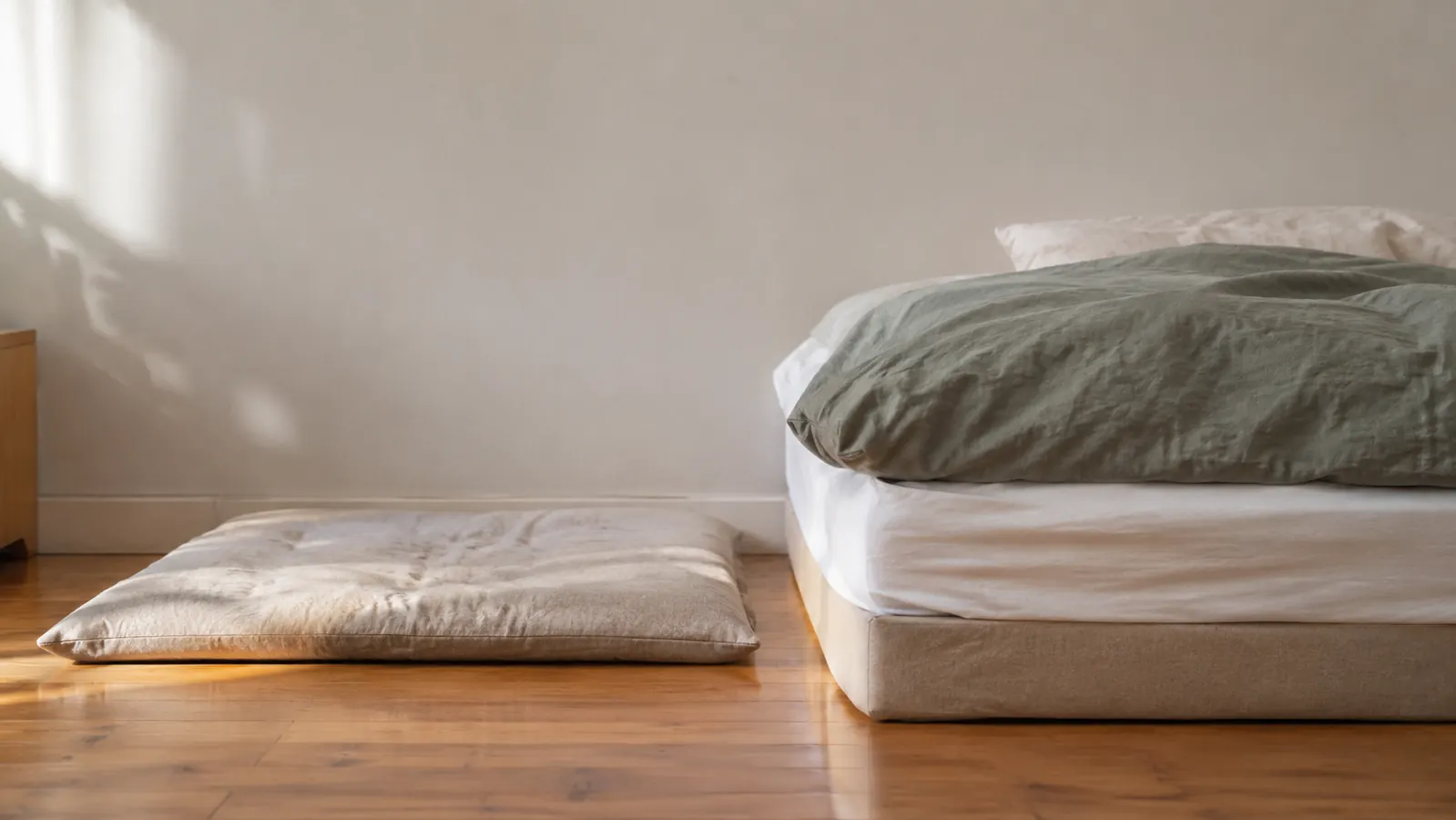
This is the part nobody puts in a review. Loose fill beds do not fail suddenly. They fail slowly, in the spots where the dog lies, and you do not notice because the dog keeps using them anyway. You notice when you press a hand into the bed and it goes flat to the floor, or when the dog starts choosing the tile instead. By then he has been lying on a thin pad for a month and you are the last one to know.
Foam fails differently. It takes longer, and when it goes you can feel it, because the base stops springing back under your hand. Fourteen months in, mine still springs back. I wash the cover every few weeks, I flip the bed when I think of it, and the base has held. That is a low bar and it clears it. The cover has been through the machine more times than I can count and the zipper still works, which is more than I can say for a jacket I own. The seams have not let go either, and that is the sort of thing you only learn after a year. I expect to replace the bed eventually and I expect to buy this one again when I do.
The Two Things I'd Check Before Buying Either
First, measure the dog stretched out, not curled up. Moose takes up most of 40 inches nose to tail when he sprawls, and a bed he has to curl on is a bed he will half fall off of. A dog that slides off at two in the morning wakes up stiff, and then you are back where you started, wondering why the new bed did not fix anything.
Second, decide honestly whether your dog will use a bed with sides. Some will not. If he has slept on the floor his whole life, the first week with a thick bed may be a negotiation. Moose took to it in two days, but he came off a cushion that was already giving him nothing, so almost anything was an improvement. Put an old towel on it for the first few nights if your dog is suspicious of new things.
Who Should Buy Which
Buy the JOYELF bed if your dog is large, older, and slow to rise. If you have watched him push up in stages, or heard his nails scramble on the floor before he gets his feet under him, the base and the side wall are the two things that help. It also makes sense if you are tired of replacing a flattened bed every few months. This one has held its shape past a year of an 82 pound dog using it daily.
Buy a standard bed if your dog is young and sound, if the bed is going in a crate or a corner where a 40 inch footprint will not fit, or if your dog is at the stage where he cannot step over a low wall at all. In that last case, a flat mat plus a conversation with your vet is a better use of the money. Ask your vet either way. I am a retired mechanic in Sacramento with one dog and one house, and I am telling you what worked here. Your dog is not my dog.
If he needs a hand getting up, give him something to push against
Solid memory foam base, machine washable cover, 100 pound weight rating, and 14 months of proof in one living room. Check today's price before you decide.
Amazon Check Today's Price on Amazon →