
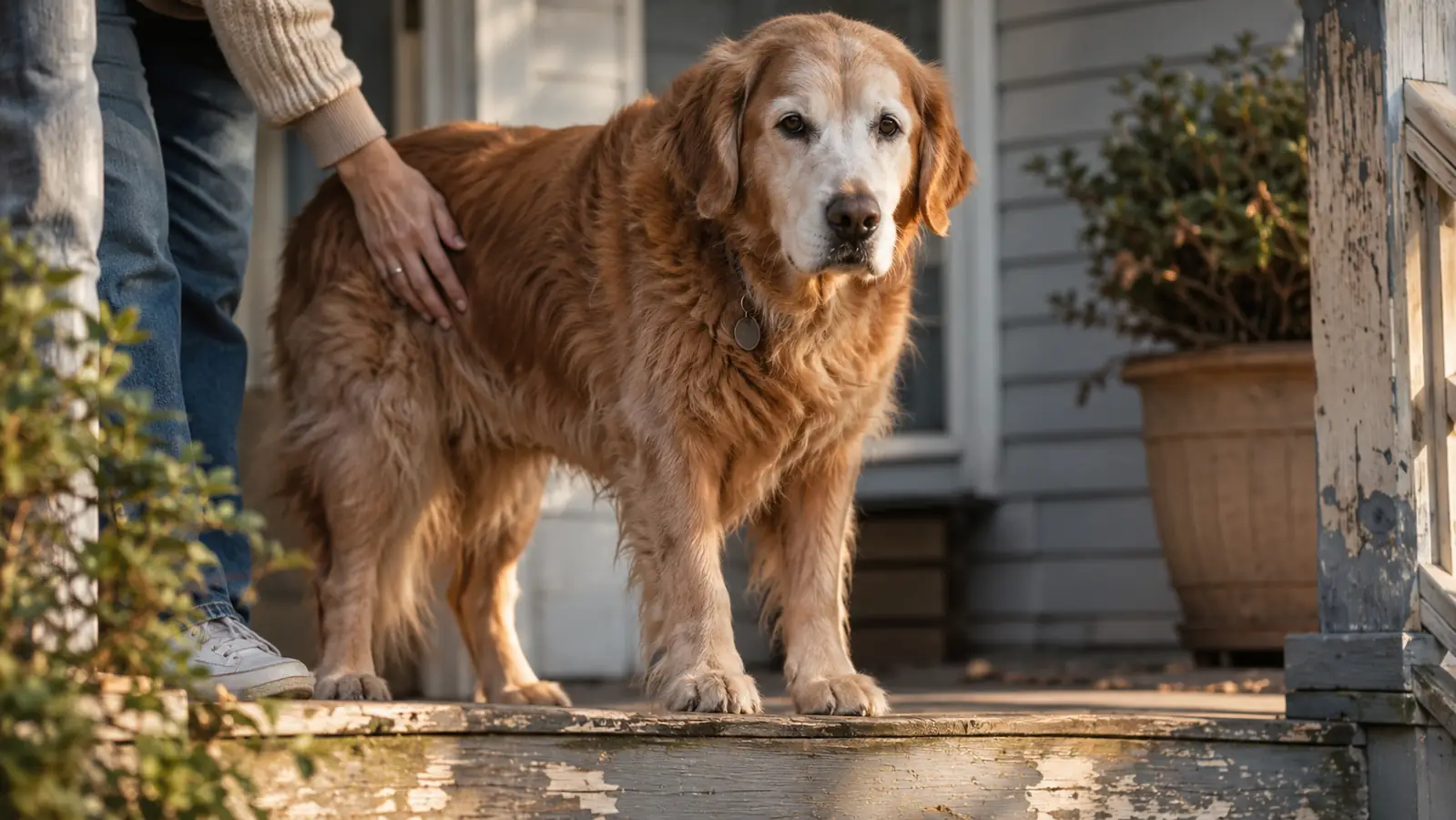
I bought the PICK FOR LIFE Lift Harness about ten months ago for one narrow job, which was getting Moose down the two back-porch steps on the mornings his hips are not cooperating. He is a ten-year-old yellow Labrador, right around 82 pounds, and my vet called early hip arthritis at his age-eight checkup. Before the harness I steadied him with a hand under the belly, and on the bad mornings a folded towel. That worked fine until the morning it did not, and I nearly went down the steps on top of him.
Most of what I read about the PICK FOR LIFE harness before ordering was either a five-star line about how much somebody loved it or a one-star line about a return. Neither told me how the thing behaves on a wet porch at six in the morning, or what it feels like to hold a third of a struggling dog's weight at the end of your arm for the length of two steps. So this is the version I wish I had read first: what this harness does well, where it annoys me after ten months, and who should not buy it at all.
The Quick Verdict
A well-built nylon lifting sling with padded handles that does one job properly. The strap takes a real afternoon to dial in, the sizing runs toward the big end, and the seven-day warranty tells you what the company expects to hear from you after week one.
Amazon Check Today's Price →The one I reach for on the mornings he will not do the steps alone
Nylon, machine washable, padded handles, and an adjustable strap that covers a wide range of big dogs. Check the size chart and today's price on Amazon before you order.
Amazon Check today's price on Amazon →What Nobody Tells You Before It Arrives
The listing sizes this X-Large and recommends it for large to extra large dogs. At 82 pounds, Moose sits at the small end of that range. The harness still fits him, but not because it was cut for a dog his size. It fits because the strap adjusts across a long span, which is the same reason it will fit a 120-pound dog without complaint. That adjustability is the feature you are paying for. It is also the first thing that will frustrate you.
Out of the package the strap is set long, and there is more of it than you expect. My first attempt had Moose practically swimming in the thing, and he sat down in the driveway, which is his answer to most proposals he does not approve of. Get a helper, put it on in daylight, and spend fifteen minutes sliding the strap and testing the lift before you need it. Learning the fit at the bottom of the stairs in the rain with a dog who is already unsteady is a bad way to spend a morning.
The listing puts the adjustable strap at 52 to 76 inches, and the closure is a drawstring rather than a buckle. That number sounds like more range than you need until you wrap a cloth tape around your dog at the widest part of his hindquarters. Moose measured 27 inches around back there in March, which put him comfortably inside the span and nowhere near either end of it. If your dog measures past 30 inches around, you are working with the last few inches of strap and you should measure twice before you order. Ten minutes with a tape measure and a length of string would have saved me the fifteen minutes in the driveway.
Here is the part nobody says out loud. The fit that works for lifting is not always the fit that works for standing around. Set the sling too far forward and you are lifting his belly, which he will hate and which does nothing for his hips. Set it too far back and you are lifting air. On Moose it lands just ahead of his hips, and it took me the better part of a week of small moves to find that spot. Once you find yours, remember it. I marked the strap position with a dab of paint so I would stop losing it after every wash. The drawstring is the one piece of hardware that needs watching, because a dog leaning into a snug sling will work it loose over the course of a week, and checking it takes about four seconds.
How I Actually Use It
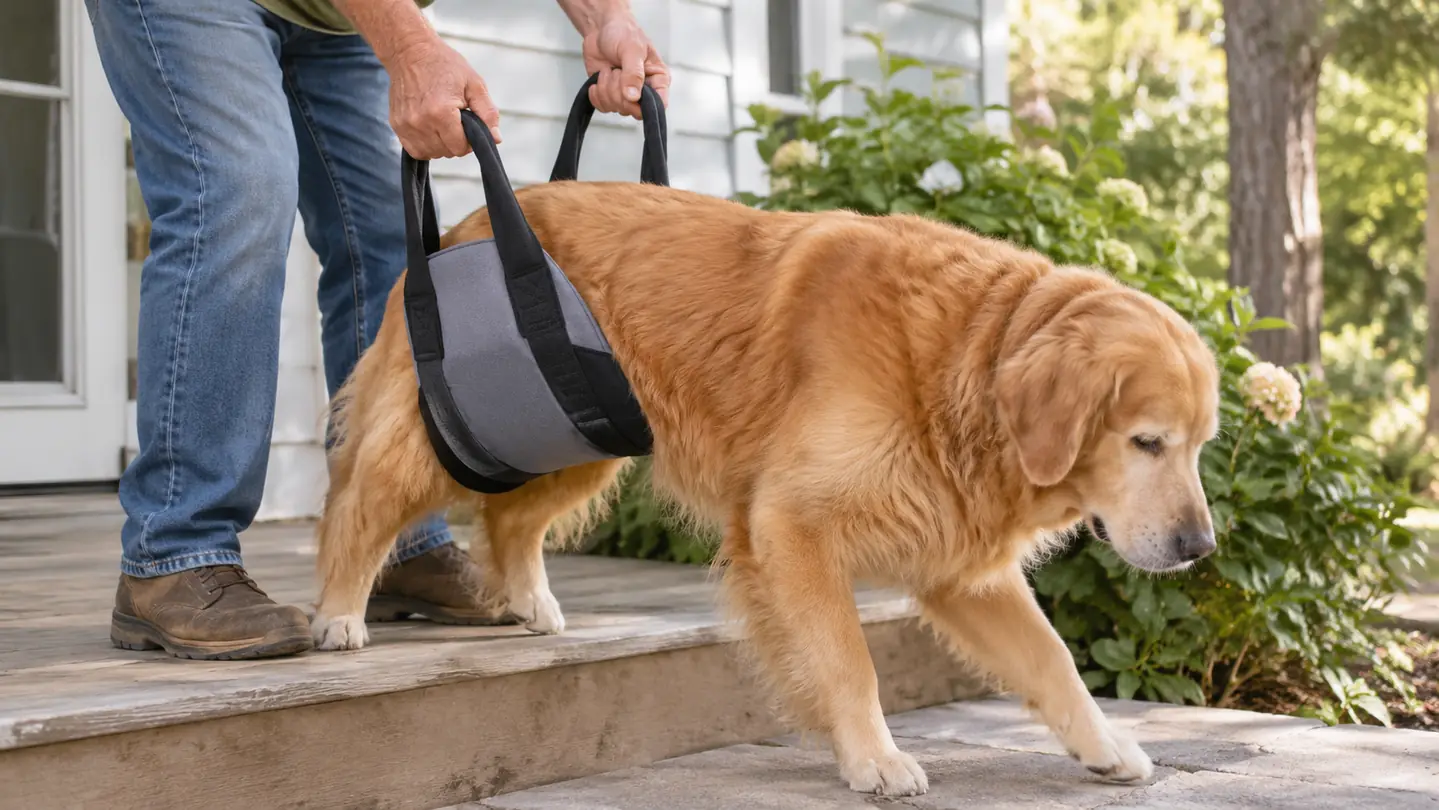
Two back-porch steps. That is 90 percent of what this harness does in my house. I settle it under his hindquarters, take a padded handle in each hand, and take maybe a third of his weight as he comes down. He does the rest. He still walks down the steps himself, and that matters to me more than it probably should. The harness is not carrying him. It is keeping him from folding.
The other use is the kitchen floor. My house is hardwood and tile, and when Moose gets up from a nap on the tile his back feet sometimes slide out from under him. The harness hangs on a nail by the back door, so when I hear that scramble I am there in a few seconds with a handle in each hand. I hold him steady while he gets his feet under himself. Thirty seconds, maybe. Then I let go and he walks off to find a cooler patch of floor.
There was a Tuesday in February that is the reason I keep this thing by the door. It had rained overnight and the porch boards were slick, and Moose came out of the house at his usual pace, which is roughly the pace of a man carrying a couch. His right rear foot went out from under him on the second board and he sat down hard on the edge of it. I had the sling on him before he finished the slide. He got his feet underneath himself, we went down the two steps together, and he never panicked, which is not nothing in a dog his age. A folded towel would have been sitting in the garage on a nail, twenty feet away and useless. That is the whole difference between the two setups.
What I do not use it for is the truck. Loading Moose into the back seat of my F-150 is a ramp job and always has been. The harness is for steps and slick spots, not for hoisting 82 pounds up and over a sill. Could you use it that way? Probably, and I am sure somebody does. I would not, because a dog being lifted has no say in where he lands, and a sling under the rear gives you no control over the front end at all.
One thing that surprised me is how much of the work the handles do. The padding means I can take his weight across my palms instead of clamping down with my fingers, which is what happens with a folded towel. Before this, my forearms were done by the time we reached the bottom of the stairs. Two steps is not much. Doing it four times a day for ten months is a different story.
Ten months, a wash every few weeks, and the nylon has not stretched, frayed, or gone soft anywhere on the strap.
What It Does Not Do
It does not build strength and it does not slow arthritis down. The harness gets Moose down two steps today. Keeping him lean and keeping him moving is what the vet told me to do about the arthritis, and that is a job for a scale, a leash, and two short walks a day. He also gets a joint supplement with his breakfast, which has been the routine since the age-eight checkup. None of that is this product's job. It is a handle, not a treatment, and anybody selling it to you as the latter is selling you something else entirely.
The actual instruction at that checkup was two things, and she was blunt about both. Keep him lean and keep him moving. Moose came in at 82 pounds and she wanted him to stay there, because every extra pound on a Labrador with arthritic hips is a pound his back end has to haul up two porch steps four times a day. So he gets measured portions now, and two walks, morning and evening, rain or not, short enough that he is not sore after but long enough that he is tired. When I let a week slide because I am busy in the garage, I can see it in how he handles the porch on Saturday. That has nothing to do with which harness is hanging on the nail, and I would be lying if I blamed the strap for it.
It also does not steer and it does not work hands-free. If your dog still moves fast and pulls, this is the wrong tool, and what you want is a walking harness instead. A rear sling is for a dog who is willing to walk and needs help doing it. If your dog is fighting you, or if he cannot put weight on the back end at all, that is a conversation with your vet about proper support, not something you solve with a strap off the internet.
Last thing on this list: it is not a leave-on harness. Most days it goes on at the top of the steps and comes off at the bottom. That is not a defect in the design. It is just what the product is, and knowing that ahead of time saves you from expecting it to be something it never claimed to be.
What I Liked
- Padded handles that let you carry a real share of the weight on your palms
- Adjustable strap covers a wide range of large dogs, so it grows with the dog
- Nylon shell, machine washable, roughly 14 ounces so it hangs on a nail by the door
- Under ten seconds to put on once the strap position is set and marked
Where It Falls Short
- Sizing runs toward extra large breeds, so an 82-pound dog carries more slack than he needs
- The strap takes a genuine afternoon of adjusting before it is right
- Seven-day warranty, which is the weakest part of the purchase
- No steering and no front-end support, so it is not a walking harness
The Seven Day Warranty Is the Weak Point
The warranty description on the listing says seven days. Read that again. Not seven months, not a year. Seven days. I have bought tape measures with better coverage. Whatever else is true about this harness, and a good deal of it is good, the company is telling you what it expects to hear from you after the first week.
In practice that means two things. Check the fit, the stitching, and the strap the day it arrives, not the weekend after. And understand that if something lets go in month eight, you are on your own. Mine has not let go. I am ten months in with no fraying and no pulled seams, and I have been harder on it than I expected to be, mostly because a ten-year-old Labrador does not always cooperate with a plan.
It is the one part of this purchase I would change if I could. Everything else has held up better than the paperwork suggests it should, which is a strange thing to write about a product somebody is trying to sell you, but it is what ten months has shown me.
What Ten Months Has Done to It
The PICK FOR LIFE harness is nylon, it goes in the machine, and it weighs about 14 ounces on the kitchen scale. It has been through the wash every few weeks since I bought it, on whatever cycle the machine was already set to, and it comes out looking very much like it went in. No pilling on the padded handles, no soft spots in the strap, no fading I can see in the daylight.
It arrived in a package about ten inches by four and a half by four and a quarter, which tells you how little there is to the thing. A strap, a pair of padded handles, the sling itself, and a drawstring. Nothing to break, no buckle to jam up with porch grit, no plastic that goes brittle in a cold snap. I wash it on cold usually and let it air dry over the porch rail rather than putting it through the dryer, and ten months of that has left the nylon stiff enough to hold its shape when I hang it up. There is no maintenance routine here. That is the entire routine.
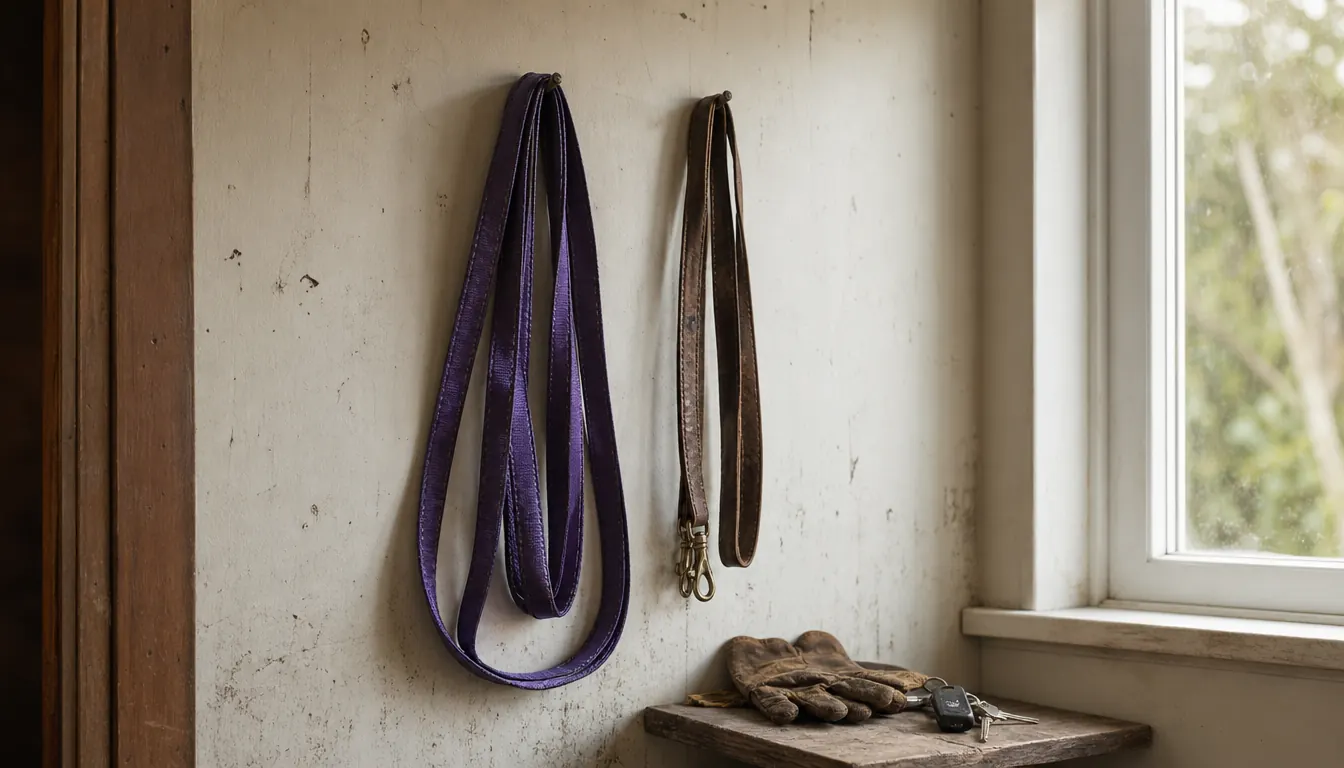
It lives on a nail by the back door, which is the real test of any dog gear. If it were a hassle to hang up, it would end up in the garage, and if it lived in the garage I would not walk out to fetch it on the mornings I actually need it. Fourteen ounces hangs on a nail just fine, and that small thing is the difference between owning a tool and owning a decoration.
Who This Is For
This is for the owner of a big dog who can still walk and still wants to, but who needs a hand on stairs, on a slick floor, or getting in and out of the car. It suits the dog who stumbles rather than the dog who cannot stand. It is also for the person doing the lifting, which at 58 and retired from turning wrenches is a real consideration for me. My back has opinions about how I spend my mornings, and it has been quieter since the harness went up on that nail.
If your dog is in that middle zone, a rear sling is a sensible way to buy him a couple more years of doing the steps himself. Ask your vet first if there is any question about whether he should be doing the steps at all. That is not a call a nylon strap gets to make, and I would not let one make it for me.
Who Should Skip It
Skip it if your dog cannot bear weight on the back legs, because a sling you hold does not fix that and your vet needs to be in the room for whatever does. Skip it if you want one piece of gear that does everything, because this is not a walking harness and it will not steer a pulling dog. And skip it if you want something you can put on once in the morning and forget about until dinner.
Skip it too if your dog is on the small side. This PICK FOR LIFE sling is sized X-Large and aimed at large and extra large breeds, and on a 40-pound dog you would be swimming in strap with a lot of excess to manage. There are smaller slings built for smaller dogs. This one is cut for the big end of the range, and Moose at 82 pounds is already near the bottom of what it was designed for. If you are anywhere near the line, measure your dog before you order rather than after.
Ten months in, it still hangs by my back door
If you have a big dog who needs a hand on the steps rather than a full-time lift, this is the one I would buy again, weak warranty and all. Check the size chart and today's price on Amazon.
Amazon Check today's price on Amazon →