
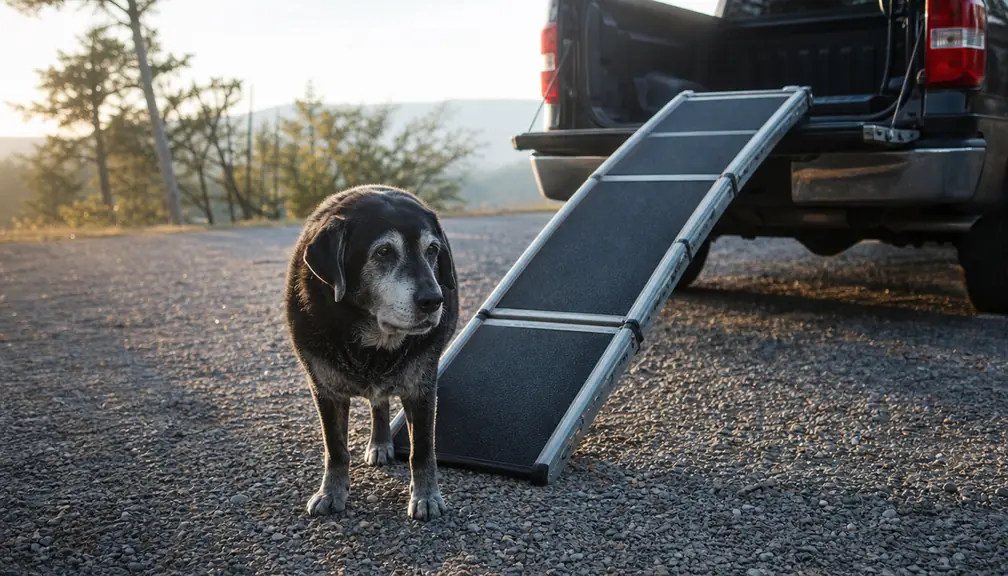
Moose turned ten this spring. He is a yellow Labrador, about 82 pounds, and his back hips have been stiff since he was eight. I am 58, retired from turning wrenches, and I am not as good at lifting 82 pounds of dog into the back seat of a pickup as I was five years ago. For a while there I did it twice a day, once in and once out, and he would brace against my forearms and I would feel every one of those pounds settle into my lower back. Something had to change and it was not going to be the dog.
About eight months ago I bought the PetSafe Happy Ride folding ramp. It is a plastic bi-fold, and the listing gives it as 62 inches long by 16 inches wide by 4 inches tall, 10 pounds, rated for 150 pounds. It lives folded against the wall in my garage and it comes out for every trip to the park or the vet. It took Moose about two weeks and a pocketful of treats to trust it. What follows is ten reasons it stayed, in the order I would explain them to a neighbor over the fence.
Ten pounds of ramp. Eighty-two pounds of dog. Only one of those should be a lift.
The PetSafe Happy Ride is a 10-pound bi-fold that rates to 150 pounds and folds down to 4 inches tall, so it hangs in the garage instead of riding in the truck. It is the difference between a slope and a dead lift.
Amazon Check Today's Price on Amazon →It moves the work from your lower back to a slope
The back seat of my 2014 F-150 sits about counter height, which is fine if you are a dog who can jump. Moose cannot. Before the ramp I lifted him, chest in one arm, rear in the other, and he helped roughly as much as a bag of sand. Now he walks up 62 inches of slope at his own pace and I stand at the bottom with a hand near his collar. I have not lifted him into that truck since spring, and my back has noticed.
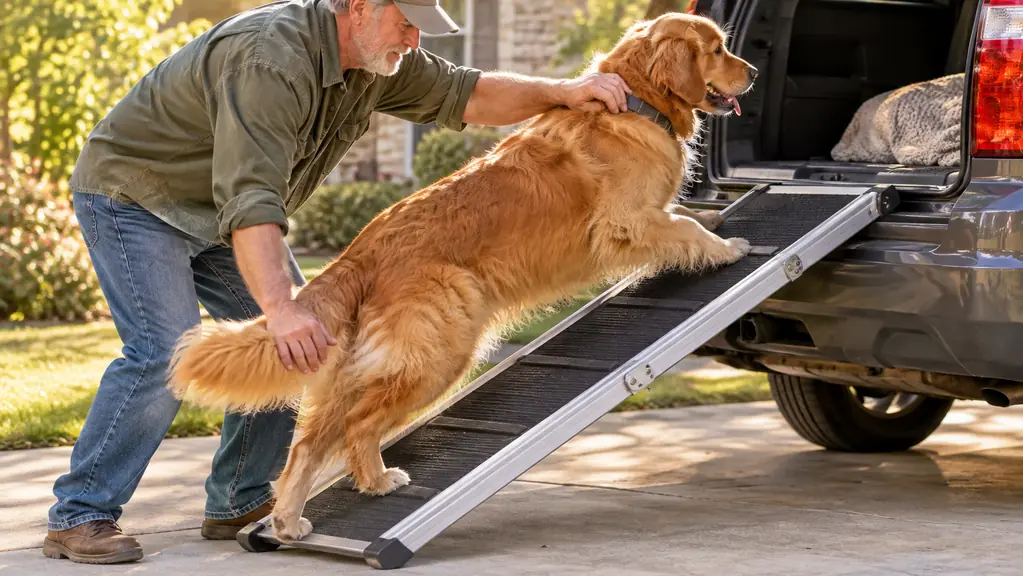
The 150-pound rating leaves an 82-pound Lab plenty of room
Moose runs about 82 pounds and he is the heaviest dog I have put on it. When he stands dead center on the treads, the deck does not bow or creak under him. That matters more than it sounds like it matters. A dog already guarding his hips will feel a ramp give underneath him, stop halfway up, and refuse to take another step, and then you are back to lifting a dog off a ramp. I have not had that happen once.
Ten pounds folds up and stays out of the way
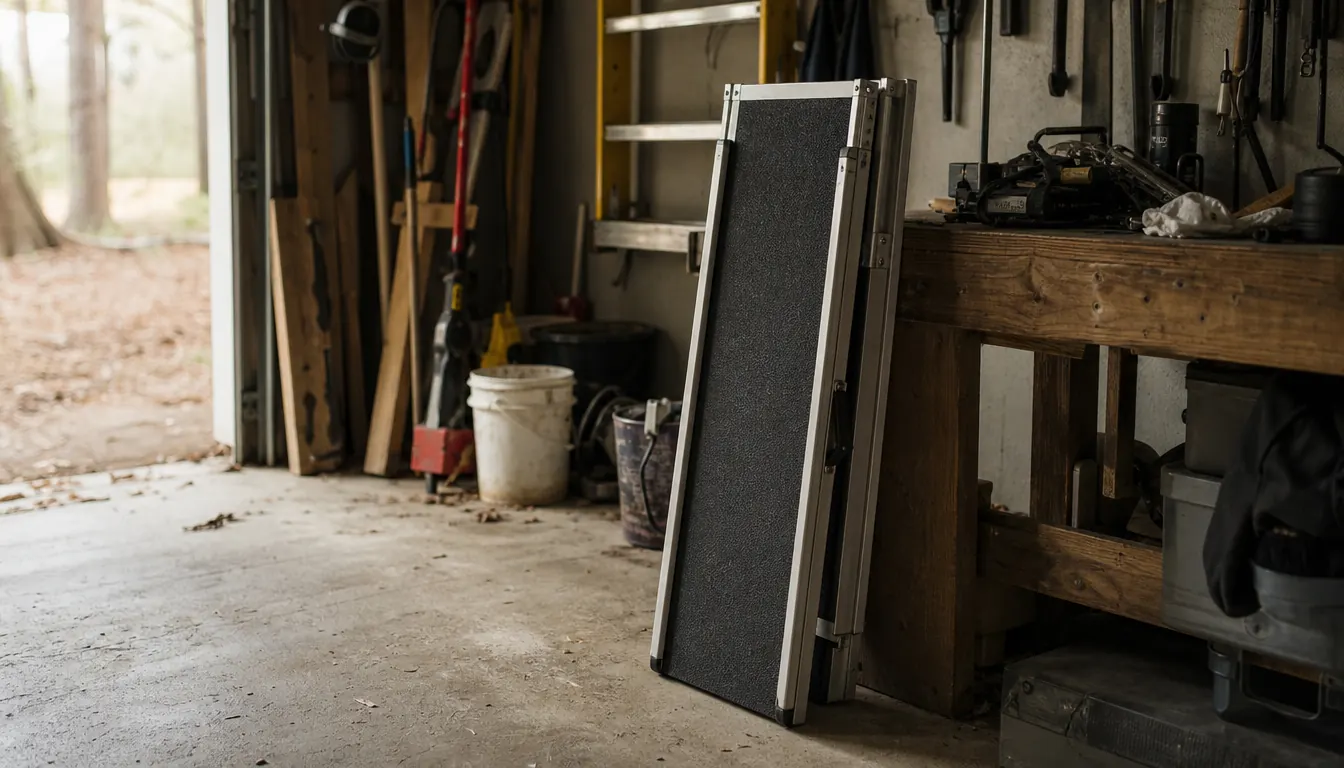
Folded, the listing puts it at 4 inches tall. Mine leans against the garage wall between the workbench and the door, and it has been there through a hot summer and a wet winter without me tripping over it. My truck is not a rolling kennel. The bed carries lumber and the cab carries groceries, so I did not want a ramp that had to live back there. The PetSafe weighs about what a gallon of paint weighs, and I can grab it with one hand.
The side rails give a worried dog an edge to feel
Moose is not a nervous dog, but he is an old one, and old dogs do the math before they commit. This ramp has rails down both sides. He can feel them with his shoulder as he goes up. Whether that is the reason he walks it straight I cannot prove, but a neighbor has a bare ramp with nothing on the sides and his shepherd stepped off the edge of it twice. On the PetSafe he knows where the ramp ends before his foot finds out.
The treads hold a wet paw
High-traction treads, per the listing. What that means in practice is that when Moose comes in from the yard with wet feet after a rain, he does not skate on the ramp the way he skates on my tile. He gets his grip and he keeps moving, and a dog with hip arthritis needs to keep moving or he stiffens up into a statue. I hose the treads off every few weeks and they have held up fine.
Ten pounds of plastic beats 82 pounds of Labrador at seven in the morning. That is not a clever line, that is just the arithmetic I do in the driveway.
The safety release latch keeps it open under him
The ramp has a safety release latch and it seats open so it does not fold up under a dog halfway through the climb. I set it, feel it catch, and then I let Moose go ahead of me. One hand releases it when we are done and it drops flat. It has folded on me zero times. I own a folding table that cannot make that claim.
Four rubber feet keep it planted on gravel
My driveway is gravel and the ramp has four rubber feet on it. They do not walk when Moose pushes off the bottom tread. On the concrete apron in front of the garage it sits the same way. If you have ever laid a board down for a dog and watched it shoot out from under him, you already know why I checked this before I bought anything.
It is built to fit trucks, and it fits my cab door
PetSafe builds this one to fit most SUVs, vans, cars and trucks. Mine is a 2014 F-150 and I set it against the rear cab door, which is where Moose has ridden since he was a pup. Sixteen inches wide is a comfortable lane for an 82-pound Lab. A narrower ramp and he would be worrying about where his back feet are going, and a dog worrying about his feet does not climb.
A slope is easier on the hips than a set of steps
I looked at folding steps before I bought this, and I judged them off the listing and a set a friend has in his garage. Steps ask a dog to pick his whole rear end up and over a rise four or five times in a row. A ramp asks him to walk. For a dog with early hip arthritis, walking is the thing my vet told me to keep him doing. She said keep him lean and keep him moving, and a slope lets him move without a jump at the end of it.
It keeps him in the truck, which keeps him in the routine
The vet, the park, the hardware store on Saturday morning. Moose has been doing those runs his whole life. When getting into the truck turned into a two-man job, the easy answer was to leave him on the porch. The ramp is the reason I did not. Eight months in, he still gets up and walks to the door when I pick up my keys, and I would buy the thing again tomorrow.
What I'd Skip
Two things I would skip. The first is a set of folding steps, at least for a dog shaped like mine, because a step is a small jump and Moose does not need any more small jumps in his day. If your dog can still hop, steps are fine and cheaper, and I am not going to pretend otherwise. The second thing I would skip is buying a ramp and considering the job done. The PetSafe gets Moose into the cab, and that is all it does. It does not make his hips better, it does not replace the joint supplement my vet put him on at his age-8 checkup, and it does not cover the slick patch of floor by the kitchen door. Keep him lean, keep him moving, and ask your vet what else your dog needs before you decide a ramp solves the whole problem.
The ramp did not fix his hips. It fixed the twenty seconds between the driveway and the back seat, and that turned out to be the part I could control.
Eight months, one stiff Lab, zero lifts into the back seat.
If your dog has started bracing when you reach for him, that is the signal. The Happy Ride folds to 4 inches, weighs 10 pounds, and takes one hand to set against the cab door.
Amazon Check Today's Price on Amazon →