
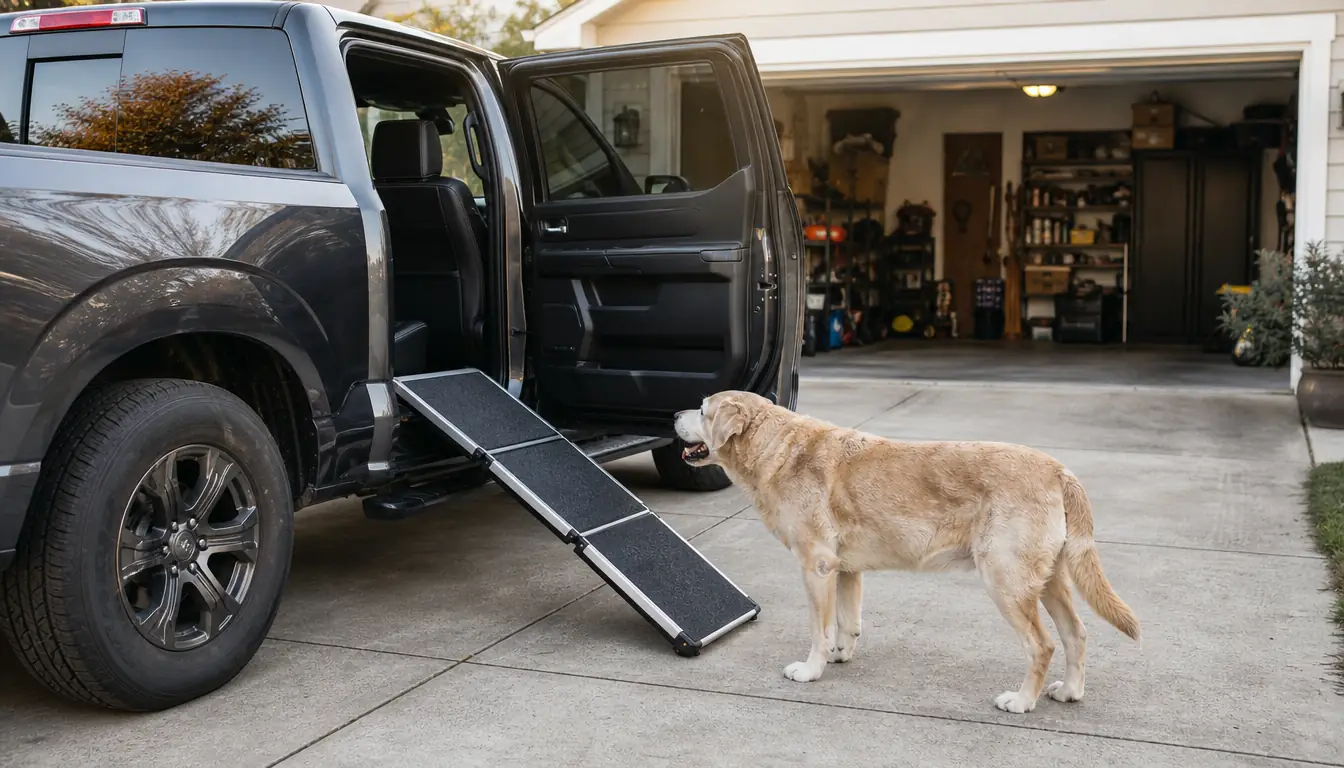
Moose is ten, eighty-two pounds, and for most of his life he loaded himself into my 2014 F-150 like the truck belonged to him. Then he quit. It did not happen all at once. First came a pause with his front paws up on the step, then a couple of false starts where he backed off and looked at me, then me standing behind him with both arms under his chest doing the work myself. Hauling eighty-two pounds of reluctant Labrador off the ground is a fine way to wreck a fifty-eight-year-old back. That is how the PetSafe Happy Ride Folding Dog Ramp ended up leaning against the wall by the rear cab door of my truck.
I have had it about eight months. It has been to the park, to the vet, to the lumber yard, and on two long drives up toward the foothills. It has been folded and unfolded more times than I can count, and it has sat through a Sacramento summer in a garage that gets hot enough to soften a plastic bucket. Here is what I found, including the parts I do not love.
The Quick Verdict
Ten pounds, sixty-two inches, and an honest fix for the truck problem. It earns its keep if you give your dog two weeks to trust it. It will not sit still on loose gravel, and it is not a substitute for your vet's plan.
Amazon Check Today's Price →The ramp that put me out of the dog-lifting business
Ten pounds, folds in half, rated to 150 pounds. Eight months on mine and it still lives in the garage instead of the trash.
Amazon Check Today's Price on Amazon →How I've Used It
The ramp lives folded in the garage, standing on end behind the shop vac. Folded it is about four inches thick, which is the number that matters when you are trying to find a place to put a thing. When we are going somewhere, I carry it out with one hand, unfold it, and set the top edge on the sill of the rear cab door where Moose rides. The four rubber feet sit on the driveway. That is the whole setup, and it takes about fifteen seconds, which matters more than I expected. A ramp you dread setting up is a ramp you leave in the garage.
The first week, Moose would not put a paw on it. I am not going to pretend otherwise. A plastic plank that shifts and clatters is not obviously trustworthy to a dog who has spent ten years jumping. What worked was laying a line of treats up the ramp and letting him take them at his own speed. No pushing, no lifting him onto it. Two weeks of that, a few minutes a day, and he was walking up on his own. PetSafe does not put a number on that adjustment period, because it depends on the dog, but plan on two weeks and be pleasantly surprised if it goes faster.
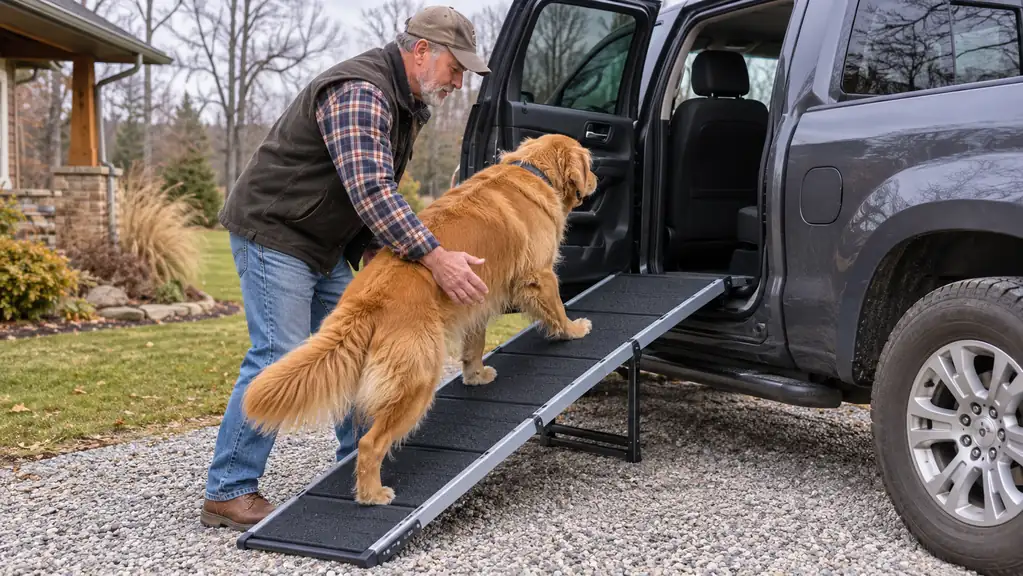
The routine now is simple. Open the door, set the ramp, and he walks up and lies down on the seat. Coming out is the part that used to worry me more, going downhill with his front end lower than his back. He takes it slow, one paw at a time, and I stand at the bottom with a hand near his chest but not on him. Eight months in, he is steadier on the way down than he was on the way up.
I still use the lift harness on the two back-porch steps on bad mornings. That is a different job and a different tool. The ramp is for the truck. I want to be clear about that, because a ramp does not replace a harness any more than a wrench replaces a screwdriver.
The 62-Inch Length Does More Work Than You Think
Sixty-two inches long, sixteen wide, four thick when folded. The length is the number I would pay attention to if you are shopping. A short ramp on a tall truck makes a steep climb, and a steep climb is exactly what a dog with sore hips cannot manage. My F-150's rear cab sill is high enough that a stubby ramp would put Moose at an angle closer to a ladder. At sixty-two inches the slope is gentle enough that he walks it instead of climbing it. That difference is the whole point of the product.
Sixteen inches of width is enough for an eighty-two pound Lab to walk without his feet hanging off the edge. I have watched him drift left on the way up, the way old dogs do, and the side rails caught his attention and steered him back. They are low rails, not walls. If your dog is the type that panics and tries to bail sideways, they will slow that down, but they will not stop it. Nothing on a ramp will stop it.
Ten pounds sounds like a line off the box until you are the one carrying it. I have a bad shoulder and I can move this thing with one hand. That also means it is light enough to shift if a dog hits it at a run. Light cuts both ways.
Latch, Feet and Treads: The Boring Parts That Matter
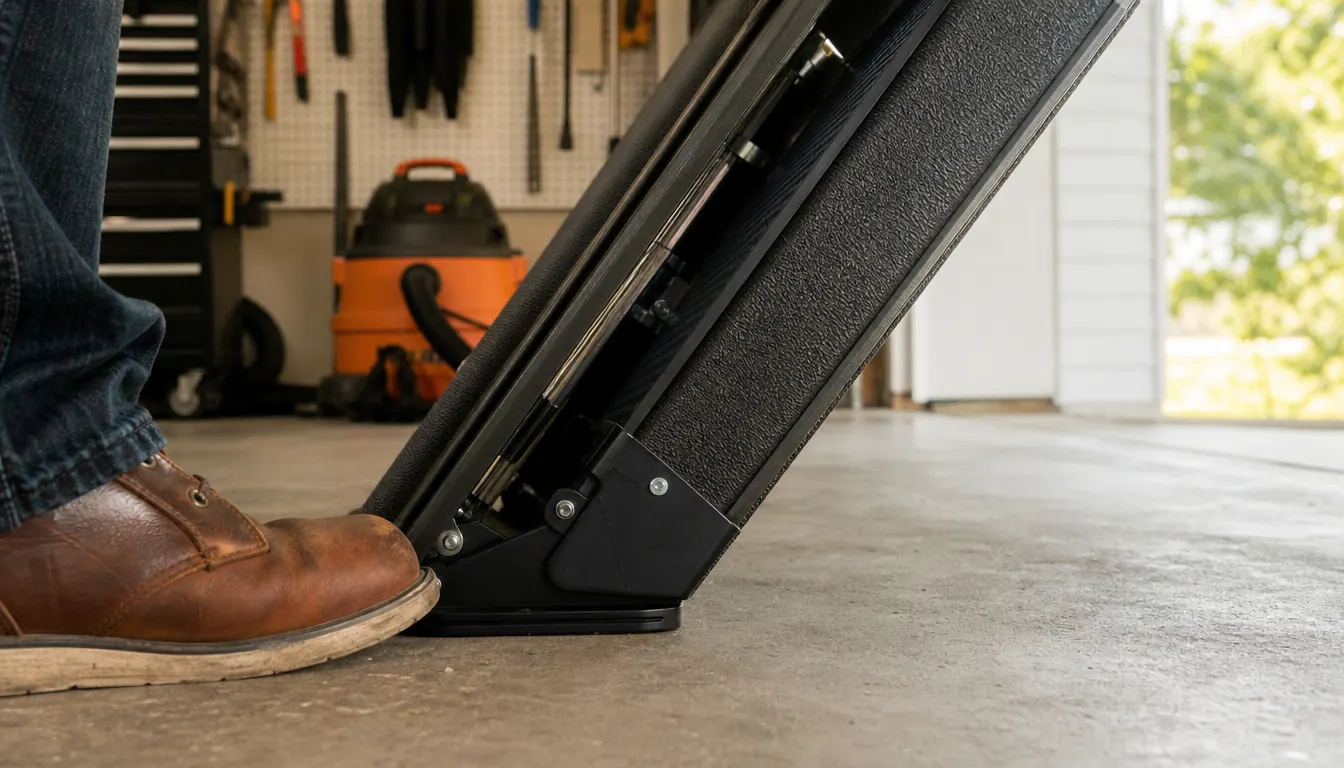
The safety release latch is the part I did not think about until I had folded the ramp on my thumb. It locks the two halves together when the ramp is open so it cannot collapse under a dog, and you have to release it on purpose to fold it back up. That is the right design. It has never let go on its own, and I have loaded Moose probably three hundred times. If you have a dog that bolts up the ramp, this is the piece of hardware that keeps the ramp from folding under him mid-stride. It is the reason I stopped worrying about a bifold ramp in the first place.
The rubber feet are the weak point, and I will tell you exactly why. On my concrete driveway they grip fine. On the gravel shoulder where I park at the park, they do the best they can and that is not much. The ramp will slide an inch or two as Moose loads, especially if the ground is uneven. I have learned to set it, step on the bottom of it to seat the feet, and then send him up. On grass it is worse. If you park on soft ground most of the time, plan on putting something solid under the feet.
The treads are a high traction surface, and they have held up. Eight months of dirty paws and one hose-down, and they still have their texture. They are not grippy like sandpaper, they are grippy like a good truck bed liner. Moose does not slip on them, and that includes wet mornings.
Eight Months In: What Held Up
The plastic has taken the wear I expected and nothing worse. There is a scuff where the top edge meets the door sill, and the treads have dirt ground into them that a hose does not fully remove. The hinge is still tight. Nothing has cracked, and the latch still snaps the way it did the first week.
What I notice most is that I stopped thinking about it. That is the highest compliment I can pay a tool. It comes out of the garage, it goes on the truck, the dog goes up, and I put it away. No fiddling, no readjusting, no cursing. The things in my garage that I curse at are the things that get replaced.
One thing I did not expect: the ramp made vet visits easier on me, not just on him. Loading a stiff dog in a parking lot while other people wait is its own kind of stress. Now I set the ramp, he walks up, I close the door, and we go. The whole production takes half a minute. If your dog is at the clinic every few months for his hips, that alone is worth the shelf space.
Eight months in, I stopped thinking about it. That is the highest compliment I can pay a tool.
What the Ramp Won't Do
It will not fix your dog's hips. It removes one hard thing from his day. Moose still gets up slow in the morning. He still takes the two porch steps one at a time. He still takes his joint supplement with breakfast and still gets walked every day, because the vet told me keeping him lean and keeping him moving matters more than anything I can buy. If you are hoping a ramp replaces the vet's plan, it does not, and nothing at the hardware store does.
It also will not work if your dog is not willing to try it. I got lucky, in that Moose is food motivated and not a panicker. A dog that is genuinely frightened of a ramp will need more time and more patience than I needed, and some dogs will never take to one. If that is your dog, steps, or a harness and a helper, may be the better answer. Ask your vet what they think your dog can safely manage, because a ramp still requires the dog to do the climbing.
One more thing. PetSafe rates this ramp to 150 pounds and Moose is 82. That is a comfortable margin, and I would not push it much past 120 with a dog that is unsteady, because an unsteady dog puts weight down hard and sideways rather than straight. The rating is a limit, not a target.
What I Checked Before I Bought It
I read the listing twice before I ordered, the way I read a parts spec sheet. The numbers I cared about were the length, the weight and the load rating. Sixty-two inches by sixteen by four. Ten pounds. One hundred fifty pounds of capacity. The length mattered because of the truck. The weight mattered because of my shoulder. The capacity mattered because Moose is eighty-two pounds on a good day and I wanted headroom, not a number that matched him exactly.
It is plastic, not aluminum, and I have gone back and forth on whether that is the right call. Plastic does not dent and it does not corrode, and a ramp that lives in a Central Valley garage and gets hosed off now and then is going to see both moisture and temperature swings. Aluminum would be stiffer. Plastic at this weight has a little give to it, and I can feel that give through the ramp when Moose is on it. It has not been a problem in eight months, but I notice it.
The warranty on the listing is one year, and that is the number I would hold any manufacturer to. I have not had to use it. The latch, the hinge and the treads are the three things that would fail first, and at eight months none of them have given me a reason to make a phone call. If something does let go at month fourteen, I will be buying another one rather than arguing about it, and I would rather tell you that now than pretend a warranty is a lifetime promise. PetSafe also builds these in the United States, which I noticed and which did not hurt.
What I Liked
- Ten pounds, carries in one hand with a bad shoulder
- Sixty-two inches of length keeps the angle gentle on a full-size truck
- Safety release latch has never let go in eight months of loading
- Side rails help a drifting senior dog stay centered
- Folds to about four inches and stands on end behind the shop vac
- Treads still grippy after eight months and a hose-down
Where It Falls Short
- Rubber feet slide on gravel, grass and any soft ground
- Needs a two week treat-based introduction for most dogs
- Light enough to shift if a dog hits it at speed
- Rated to 150 pounds, so not for the giant breeds
Who This Is For
This is for the owner of a big dog who has stopped loading himself and who is heavy enough that lifting him is a bad idea for your back. It suits a full-size truck or a tall SUV, where the length actually buys you a gentle angle. It suits a dog that is stiff rather than paralyzed, one who can still walk and climb but should not be jumping. And it suits somebody who wants fifteen seconds of setup, not five minutes. If that describes your situation, this is the first thing in the mobility lineup I would buy, before the harness and before the socks.
Who Should Skip It
Skip it if your dog is too frightened to be talked onto it after a couple of weeks of treats, because no amount of ramp fixes fear. Skip it if you drive a low car, where the height difference is small and the length is just one more thing to store. Skip it if your dog is over the weight rating, or if he cannot bear weight on a hind leg, because a ramp assumes the dog does the work and a dog with a bad knee that cannot push off will need a sling and a helper instead. Skip it too if you park on gravel every day and do not want to carry a board to put under the feet. That last one is a real annoyance and I would not talk you out of it.
Eight months, three hundred loads, still in the garage
If your dog has quit jumping into the truck, this is where I would start. Ten pounds, sixty-two inches, rated to 150. Check the current price and the return window before you buy.
Amazon Check Today's Price on Amazon →