
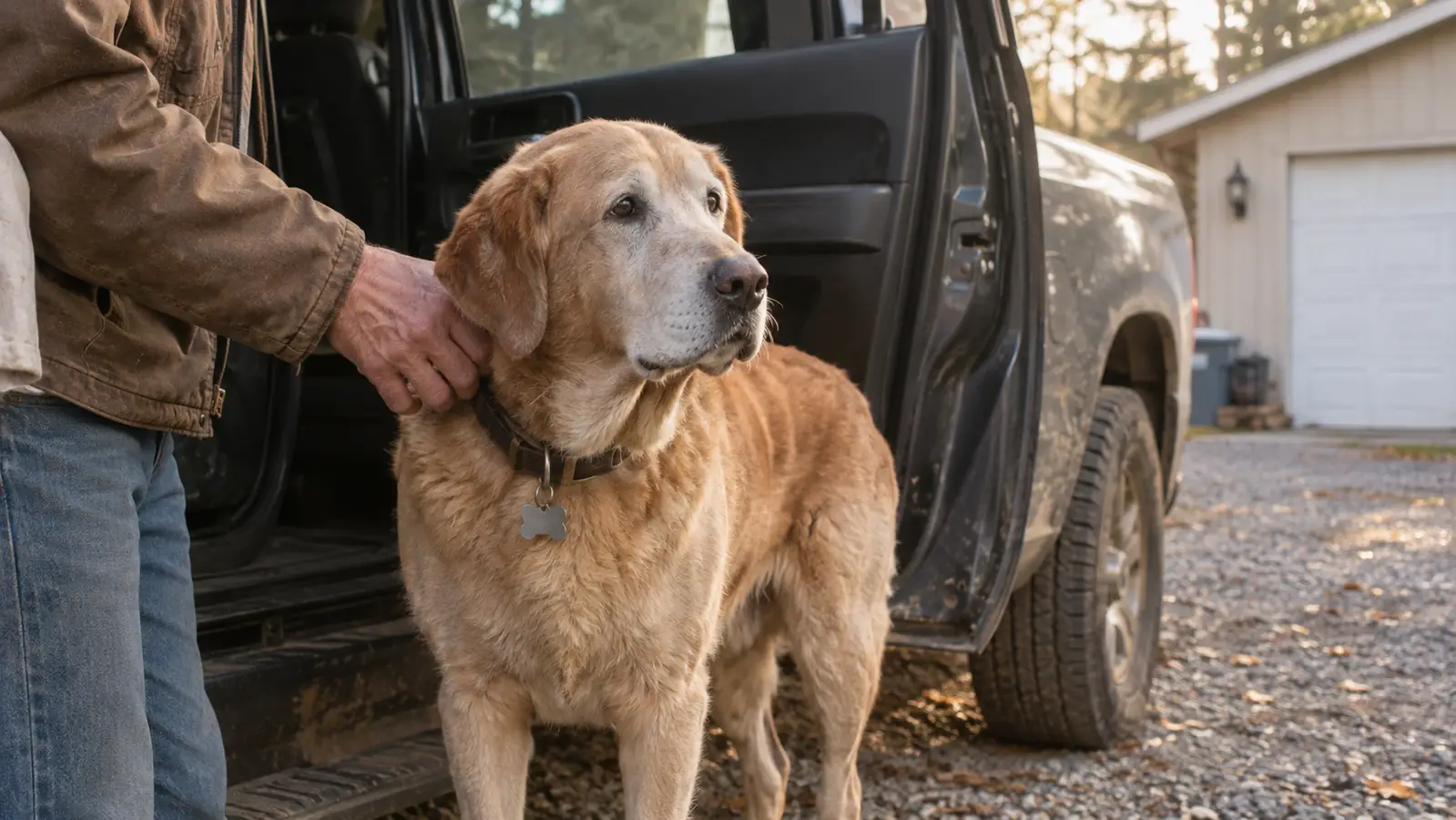
Moose is 10 years old, about 82 pounds, and a yellow Lab, which means the back seat of my 2014 F-150 sits roughly at his chest. For the better part of a year I lifted him in and out by hand. Then he started planting his front paws on the door sill and bracing, and I could feel him deciding not to commit, and I decided we were both going to get hurt if I kept doing it that way. I bought the PetSafe Happy Ride Folding Dog Ramp eight months ago. My neighbor two streets over has a set of dog steps for his dog, and I have watched Moose on those as well. So this is not a guess.
The short answer: for a big senior dog and a tall vehicle, the ramp is the better tool, and it wins on the part that actually matters, which is how much work goes through the back end. Dog steps win on setup time, on tight parking, on cost, and on the small number of dogs that will not walk up an incline no matter what you set in front of them. Small dog or low car, buy the steps. Eighty-pound Lab with early arthritis and a pickup, buy the ramp. The rest of this is why.
| PetSafe Happy Ride Ramp | Dog Steps | |
|---|---|---|
| Getting into a full-size truck | 62 inches of run reaches the rear cab door at a shallow angle | Has to be tall to reach a pickup, and tall sets get narrow near the top |
| Work through the back hips | One continuous climb, one push-off | Four or five separate push-offs, twice per trip |
| Width and footing | 16 inches wide, low side rails, four rubber feet, high-traction treads | Varies by set, and the top step is usually the narrowest |
| Rated capacity | 150 pounds, with margin for an 82-pound dog | All over the map, and the rating is buried in the listing photos |
| Storage | Folds to about 4 inches thick, 10 pounds, stands against a garage wall | Rigid and bulky, takes floor space or truck bed space |
| Setup at the vehicle | Unfold, set, latch, check the feet | Nothing to set up at all |
| Tight parking | Needs 62 inches of clear space behind the vehicle | Fits in a gap a third that size |
| A dog that refuses an incline | Took two weeks of chicken before Moose would commit | Flat steps are easier for a nervous dog to read |
| Upfront cost | Costs more than a basic set of steps | Cheaper for a small dog and a low car that do not need the reach |
| Best for | Big dogs, tall vehicles, sore hips | Small dogs, low cars, tight parking |
How I Compared Two Things I Only Own One Of
I should be straight with you: I have never bought dog steps. Everything I say about them comes from three places. The first is the listings themselves, which are worth reading closely because the weight rating and the step height are usually buried somewhere in the fifth photo. The second is my neighbor's plastic four-step set, which I have watched his dog use and which I once set Moose on in the driveway just to see what he would do. His set lives under a bungee cord in the bed of his truck, and the thing I noticed standing next to it is that the top platform is the narrowest of the four. That means the dog has the least room to stand right where he is highest up and least steady. That is true of most of the sets I have looked at since. The third source is my vet, who has been telling me since Moose's age-eight checkup to keep him lean and keep him moving, and who did not sell me a thing.
What he said about ramps versus steps was less dramatic than I wanted it to be. He said the dog that keeps moving is the dog that does better, and that whatever Moose would actually use beats whatever looked better on paper. He did add one thing that stuck with me. Four or five separate push-offs to get up into a truck is more total work through the back end than one continuous slope, and a dog with sore hips feels that difference by the end of the day. He also asked me whether Moose would get up on a slope at all, which I had not thought about until that moment. That matched what I was seeing at the truck, so I stopped shopping and started training.
Where the PetSafe Happy Ride Ramp Wins
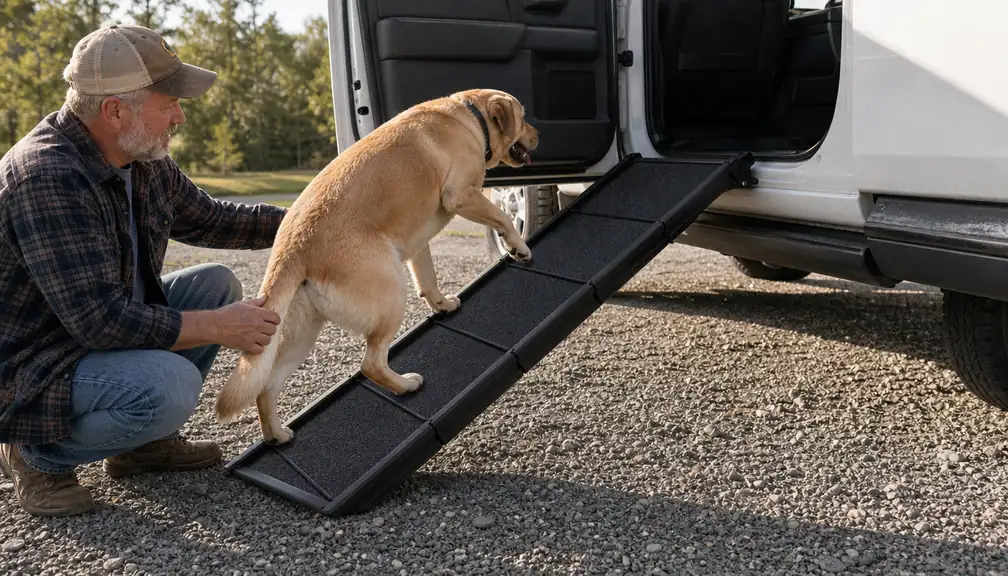
The ramp is 62 inches long, and that length is the entire point. It turns a 30-inch climb into a long, shallow walk, so Moose goes up in one motion instead of loading and unloading each hind leg four separate times. At 82 pounds, that matters more than every other feature on the list. The ramp is rated to 150 pounds, which leaves a big dog real margin, and the 16-inch width means he is not walking a balance beam. Sixteen inches is wider than it sounds, too. Moose is not a wide dog, but he is long, and the extra width means his back feet land where his front feet landed instead of on the edge. The 150-pound rating is generous for him at 82, and I would rather have a ramp overbuilt for my dog than one rated at exactly his weight on a good day. The side rails are lower than I would like, but they are there, and I have watched him drift into one on a windy morning and correct himself without breaking stride.
It is plastic, it weighs 10 pounds, and it folds in half to roughly 4 inches thick. I keep it standing against the wall in the garage next to the door I actually use, and I can carry it out with one hand while holding a leash in the other. The safety release latch has never let go on me. The four rubber feet sit flat on my gravel driveway instead of skating out from under him when he pushes off, and the high-traction treads are the difference between a dog that trusts the thing and a dog that does not. Moose trusts it.
Here is the part that does not make it into a listing. The ramp asks the dog to make one decision. Steps ask him to make four or five in a row, and a dog with sore hips negotiates every single one of them. Moose committed once and then stopped thinking about the truck at all, which is the outcome I was actually paying for.
Where Dog Steps Win
Setup. That is the first one and I will not pretend otherwise. A set of steps comes out of the truck bed or off the garage shelf and it is already in position. The ramp has to be unfolded, set, latched, and lined up, which takes me maybe fifteen seconds, and takes longer when it is raining and I am holding a leash and a bag of poop. In a tight lot, the ramp needs 62 inches of clear space behind the truck. Steps need about a third of that. If you park on a city street every day, the ramp will annoy you in a way the steps will not.
Second, some dogs simply will not do an incline. My neighbor's dog took to those steps in one afternoon because each step is a flat surface he can see and understand. Moose needed two weeks of chicken before he would put all four feet on the ramp, and there are dogs who would never make that leap at all. If yours is one of them, buy the steps and stop reading about ramps. Third, cost: a basic set of steps is cheaper than the ramp, full stop. For a 20-pound dog and a sedan, steps do the job with less money and less floor space in the garage.
The ramp did not make Moose younger. It removed the two hardest moments of his day, and that is a smaller claim and a truer one.
The ramp that got an 82-pound Lab into a pickup without being lifted
Rated to 150 pounds, 16 inches wide, 10 pounds folded, with a latch that holds and feet that stay put on gravel. The one that lives by the garage door.
Amazon Check Today's Price on Amazon →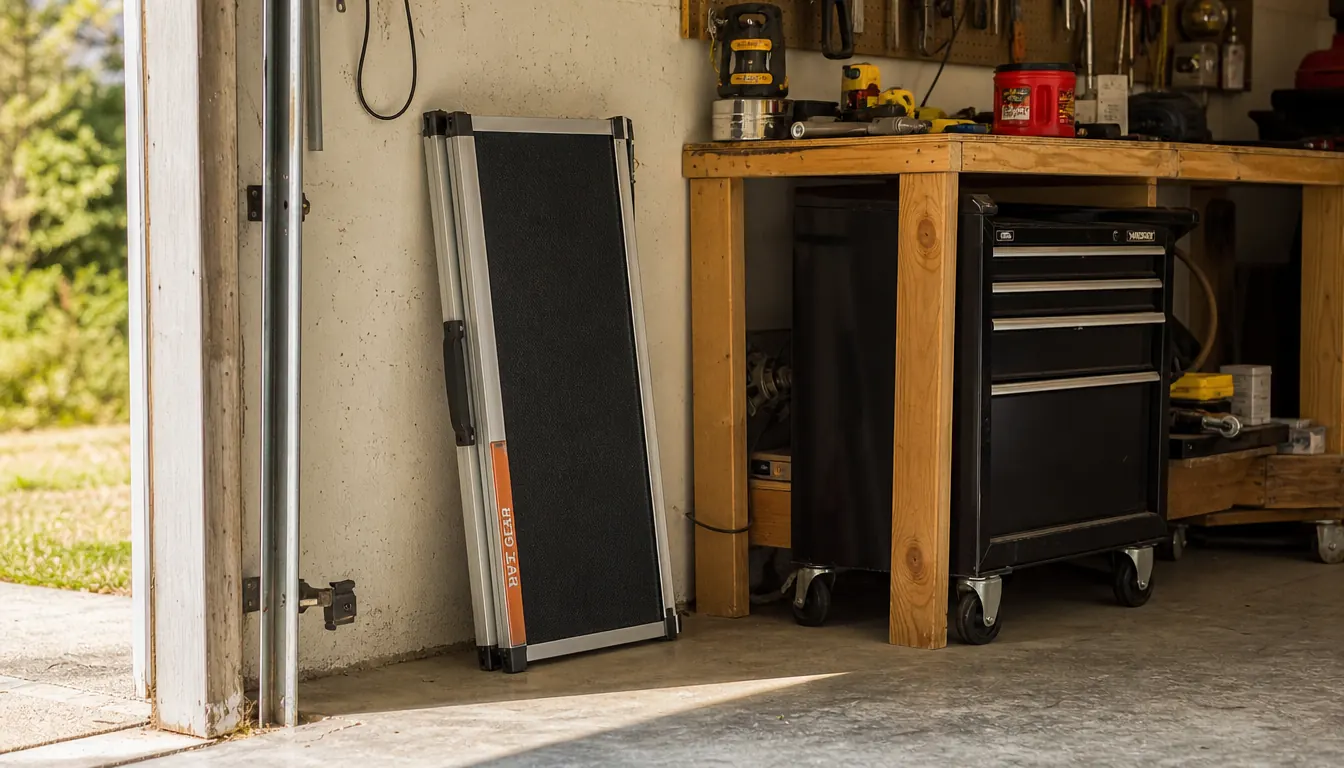
The Height Question, and Why a Truck Is Different From a Car
A full-size pickup is the hard case, and it is where this comparison actually gets decided. The rear cab door sill on my F-150 sits high enough that a set of steps built for a truck has to be tall, and tall sets get narrow and nervous near the top, which is the exact spot where a big dog is least steady. The ramp solves height with length instead. It spreads that climb over five feet of shallow incline, so the top of the climb is the same easy grade as the bottom. I measured the drop from my gravel to that sill once, out of curiosity, and then I quit, because the number did not change anything. What changed things was standing behind the truck and watching where Moose actually put his feet.
On a sedan or a small SUV the math changes and the case for the ramp gets weaker. The height you are bridging is smaller, the space behind the car is smaller, and a compact set of steps handles a 15-inch sill without any drama. I would not talk a sedan owner into a five-foot folding ramp. The ramp earns its keep when the drop is tall, the dog is heavy, and the ground behind the vehicle is flat enough to set it on.
What Eight Months Actually Looked Like
The first week was a waste of good chicken. Moose would put his front feet on the ramp, look back at me, and step off. The problem was mine: I had been parking close to the garage, which shortened the run and steepened the angle. Once I backed the truck out onto the flat part of the driveway, the incline flattened and he walked up on the third try like he had been doing it his whole life. If you take one thing from this, take that. The ramp is only as good as the ground under it and the angle you give it.
Since then it has been boring, which is exactly what I wanted from a piece of mobility gear. It comes out, he goes up, I fold it and put it back. Twice I set it on wet grass at a park and had to move the truck, because the feet wanted to sink. The treads collect grit, so I knock it against the driveway every couple of weeks. The trip that convinced me was a vet appointment back in February. Cold morning, truck backed onto the flat, ramp down, and he was up and sitting before I had the leash sorted out. Two years ago that same trip started with me grunting and him bracing. The one thing I would change is the side rails, which are lower than I would like for a dog who sometimes leans on the way up. That is a small complaint about a tool that has kept me from lifting 82 pounds twice a day for most of a year.
Who Should Buy Which
Buy the PetSafe ramp if your dog is over about 50 pounds, your vehicle sits tall, and your dog has started hesitating at the door. Buy it if you have been lifting a big dog and your back has opinions about that. Buy it if your dog is food motivated and will follow a piece of chicken up a slope for a week, because that is the whole training curve. Do not buy it if you park on a narrow street, if you have nowhere flat to set it, or if your dog shuts down at anything angled. None of those are failures of the ramp. They are just jobs it was not built for.
Buy dog steps if your dog is small, your car is low, your parking is tight, or your dog has already told you clearly that he will not walk an incline. Buy steps if you want zero setup and you want to spend less. Steps are not the compromise option. For a lot of dogs they are the correct one, and I would rather you buy a set of steps your dog uses than a ramp he refuses. The dog decides this, not the listing.
For us, the ramp was the right call, and eight months in I would buy it again tomorrow. Moose gets in and out of the truck on his own four feet, I keep my back, and the whole transaction takes about fifteen seconds at the tailgate. That is not a transformation. It is just one hard part of an old dog's day made easier, which is all I was after in the first place.
If your dog is heavy and your truck is tall, this is the one to get
62 inches of shallow incline, 150-pound rating, folds to 4 inches and 10 pounds. Eight months of daily use on a 2014 F-150 and it still sets up in one motion.
Amazon Check Today's Price on Amazon →