
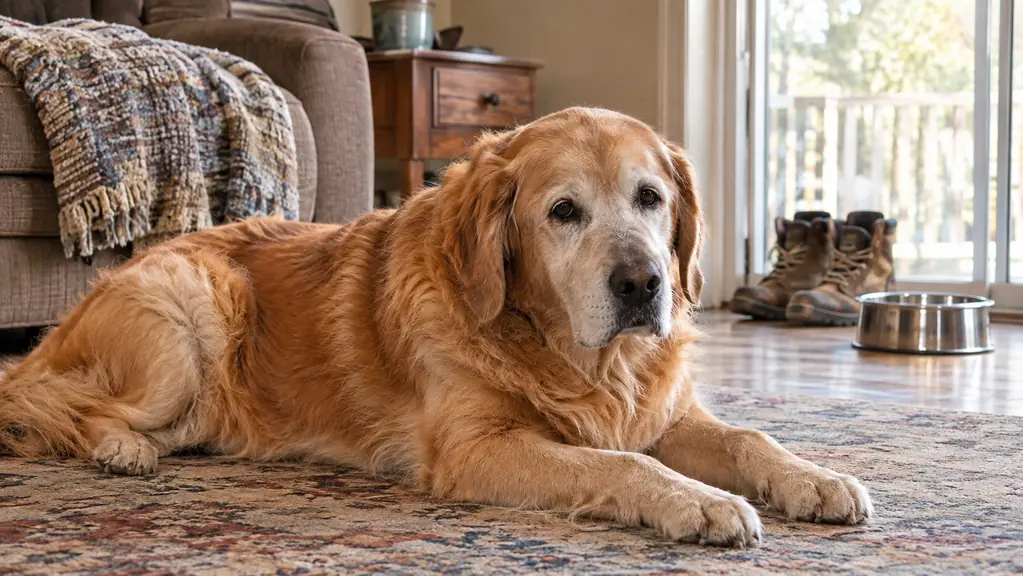
I did not want to write this one. Not because Cosequin failed on Moose, but because the honest version of the story is quieter than the version most people are shopping for. Moose is a 10-year-old yellow Lab, about 82 pounds, and my vet found early arthritis in his hips at his age-8 checkup. I started him on Nutramax Cosequin that same week. He has taken it every morning for roughly two years now. That is the whole recommendation. No dramatic before and after. No dog sprinting up a hill. Just a dog who gets off the floor a little easier than he did two winters ago.
Here is why that is worth a full article anyway. Most of what gets written about this product is either a five-star review posted in week two or a one-star complaint posted in week three, and both are useless, because this supplement does not work on either timeline. It works slowly, when it works at all, and it works on some dogs and not others. What follows is the version I wish somebody had handed me before I bought the first bottle: what it actually did, what it plainly did not do, and the parts of the daily routine that still irritate me.
The Quick Verdict
Slow, honest support for a large older dog with mild hip stiffness. Not a painkiller, not fast, and not a substitute for fixing the floor and the weight.
Amazon Check Today's Price →The label I read before the first bottle
Two years in and Moose still takes one chewable in his breakfast. If you want to see the ingredient panel and the count before you commit, start with the current listing.
Amazon Check Today's Price on Amazon →What Nobody Tells You Up Front
Cosequin is not a painkiller. That ought to be printed across the front of the bottle in type bigger than the brand name. It does not stop pain the way a prescription does. It does not calm an inflamed joint by tonight. It will not get a dog up a set of stairs he has decided he cannot manage. What it is, per the panel, is joint support: glucosamine hydrochloride at 600 mg, sodium chondroitin sulfate at 300 mg, and MSM, in a chicken-flavored chewable tablet. Support is a much smaller word than most buyers hear when they read a shelf label.
The second thing nobody says plainly is that this is a supplement, not a prescription. Nutramax has been making it a long time and it is the brand most vets reach for first, which is exactly why I started there instead of with whatever was on sale. But most recommended is not the same as guaranteed to work on your dog. My vet's framing was blunt and I have kept it: try it for two months, then judge by how the dog moves, not by how you feel about having bought something.
Third, the count goes faster than you think. Sixty tablets, and at one a day for a dog Moose's size that is about two months, so you are reordering on a schedule whether you feel like it or not. The one time I let the bottle run dry for three weeks, I watched the morning stiffness come back. I keep the next bottle in the garage cabinet now, before the current one empties. That sounds like a small detail. It is the most common way people accidentally test the wrong thing.
One more thing about the recommendation itself. I did not do a deep comparison of the whole category before I bought. I went with the brand my vet named, and I have not had a reason to regret it. Since then I have read other labels out of curiosity, and the glucosamine numbers are not wildly different across a lot of them. The differences tend to sit in the form and the carrier ingredients. So take my two years as one dog's experience with one bottle, not as proof this beats everything on the shelf. I have not tested everything on the shelf.
The Nutramax panel is short, which I appreciate. No proprietary blend with a name that means nothing, no long list of ingredients I cannot pronounce. Chicken flavor, tablet form, listed for large breed sizes. That is the whole spec sheet and it fits on the back of a bottle you can hold in one hand. If you are the type who wants to read the label before spending anything, this product makes that easy.
What It Actually Did for Moose, and When
The change did not show up in week one. Somewhere around week six or seven I noticed Moose standing up from a nap in one motion instead of two, and I noticed he had stopped doing that small pause at the top of the back-porch steps before he took them. That is the entire observable result. He still takes those steps one at a time. He still cannot get into the bed of my F-150 under his own power and he is not going to. But mornings got less grim, and mornings are where arthritis shows itself first.
I keep a notebook in the garage for truck maintenance, and I started adding a line for Moose: how he got up that morning, scored one to five. The first four weeks averaged about a two. Months two through four averaged a three, with worse days when the weather turned cold and wet. By month six he was a steady three with an occasional four. He has never been a five. If a five is what you are waiting for, this is not the product that gets you there, and I am not sure anything is.
What did not change matters just as much. His grip on the hardwood did not improve at all. Cosequin does nothing for traction, and that first winter he was still sliding on the hallway tile exactly as before. That is a floor problem, not a supplement problem, and I handled it separately. Same story with the truck. He needed a ramp, not more glucosamine. If you are reading this hoping a chewable fixes the loading problem, save yourself the two months.
The first four weeks averaged about a two. By month six he was a steady three. He has never been a five, and I am not sure anything gets him there.
The Downsides Nobody Puts in the Review
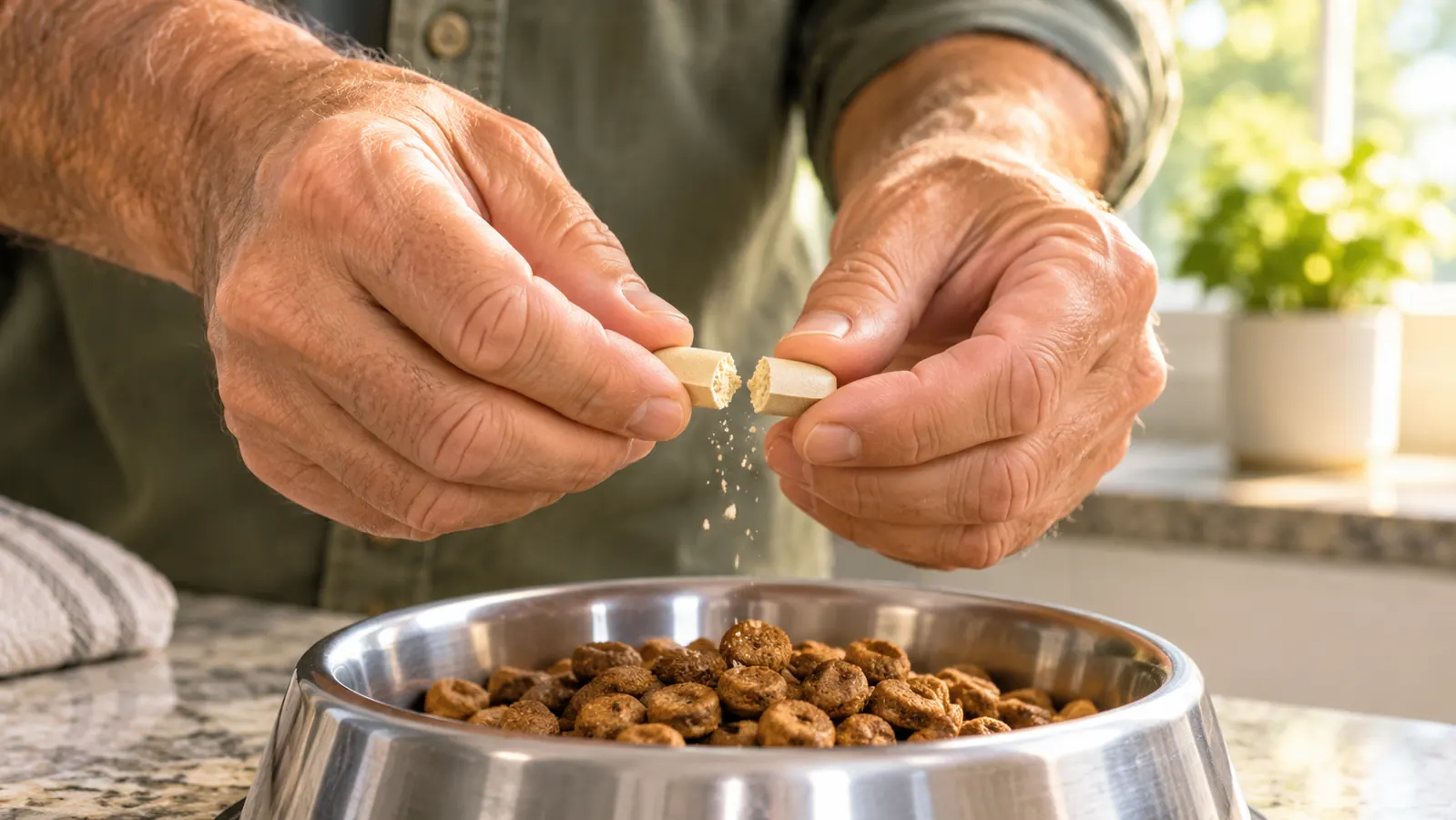
The tablet is not small. It is a chewable and Moose is a Lab, so he would eat a lug nut if I dropped it in his bowl. But if you have a picky dog, or a smaller dog, understand that you are dealing with a substantial chewable that some dogs will chew around and leave sitting in the bowl. I split his in half and press it into the kibble with a splash of warm water. Two years and he has never once left it. I have heard from people whose dogs did.
The smell is real. Chicken-flavored supplement smells like chicken-flavored supplement, and it will scent whatever drawer or cabinet you keep it in. Mine lives in a sealed container in the garage. The bottle is 2.75 by 2.75 by 5.25 inches and weighs 8 ounces, easy to store and easy to knock off a shelf.
The cost never stops, and that is what actually makes people quit. This is not a six-week course. It is a daily habit for the rest of the dog's life, and if you start at eight and the dog makes fourteen, that is a long string of bottles. I will not pretend that is nothing. I will say I have spent more on things that did less.
Here is the part no five-star review will tell you. I cannot prove the Cosequin is what helped. That same year Moose lost a few pounds, started sleeping on a better bed, and started walking shorter loops more often. Any one of those could be carrying the load. What I can tell you is that during the three-week stretch when I ran out, the notebook scores slid back toward two and came back up about a month after I restarted. One dog, one notebook, no control group. That is the real strength of the evidence and you should weigh it accordingly.
If I could change three things about the product, none of them would be the formula. I would print the give-it-eight-weeks message right on the bottle, because quitting early is the main way this fails. I would set the count in bigger type, since sixty sounds like plenty until you divide it by sixty days. And I would make the tablet break more cleanly, because it splits fine but crumbles at the edge and I end up with powder in the bottom of the bowl.
What I Liked
- Chicken-flavored chewable that most dogs take as a treat without a fight
- Readable panel: 600 mg glucosamine hydrochloride, 300 mg chondroitin, plus MSM
- Daily joint support that fits an existing breakfast routine in about ten seconds
- My own morning score went from about a two to a steady three over six to eight weeks and held there
Where It Falls Short
- No effect at all on grip, traction, or getting into a truck
- Sixty count means a reorder roughly every two months
- Not a painkiller, so bad days still happen
- Noticeably chicken-scented, and the chewable is large
- Slow enough that most people quit before it has a chance
How Long It Took, and Why Most People Quit Early
Eight weeks is where I would set the expectation, knowing your dog might be faster or slower. That number matters because the return window on most things in life is thirty days. People buy a joint supplement, give it three weeks, see a dog who is exactly as stiff as he was before, and decide they were taken. Three weeks is nothing for a joint. My vet told me to judge at eight and that is what I would pass along to you.
The other reason people quit is that they watch for the wrong thing. They expect trotting. What usually happens is smaller than that. The dog stops hesitating at the stairs. The dog stops circling three times before he lies down. The dog is less stiff for the first hour after a nap. If you are not looking for small changes, you will miss them and quit something that was quietly working.
So pick one thing before you start and write it down. Just one. How long it takes him to get off the floor in the morning, or whether he hesitates at a particular step. Check it again at eight weeks. That is a better test than any review on the internet, mine included.
How It Fits With Everything Else I Do
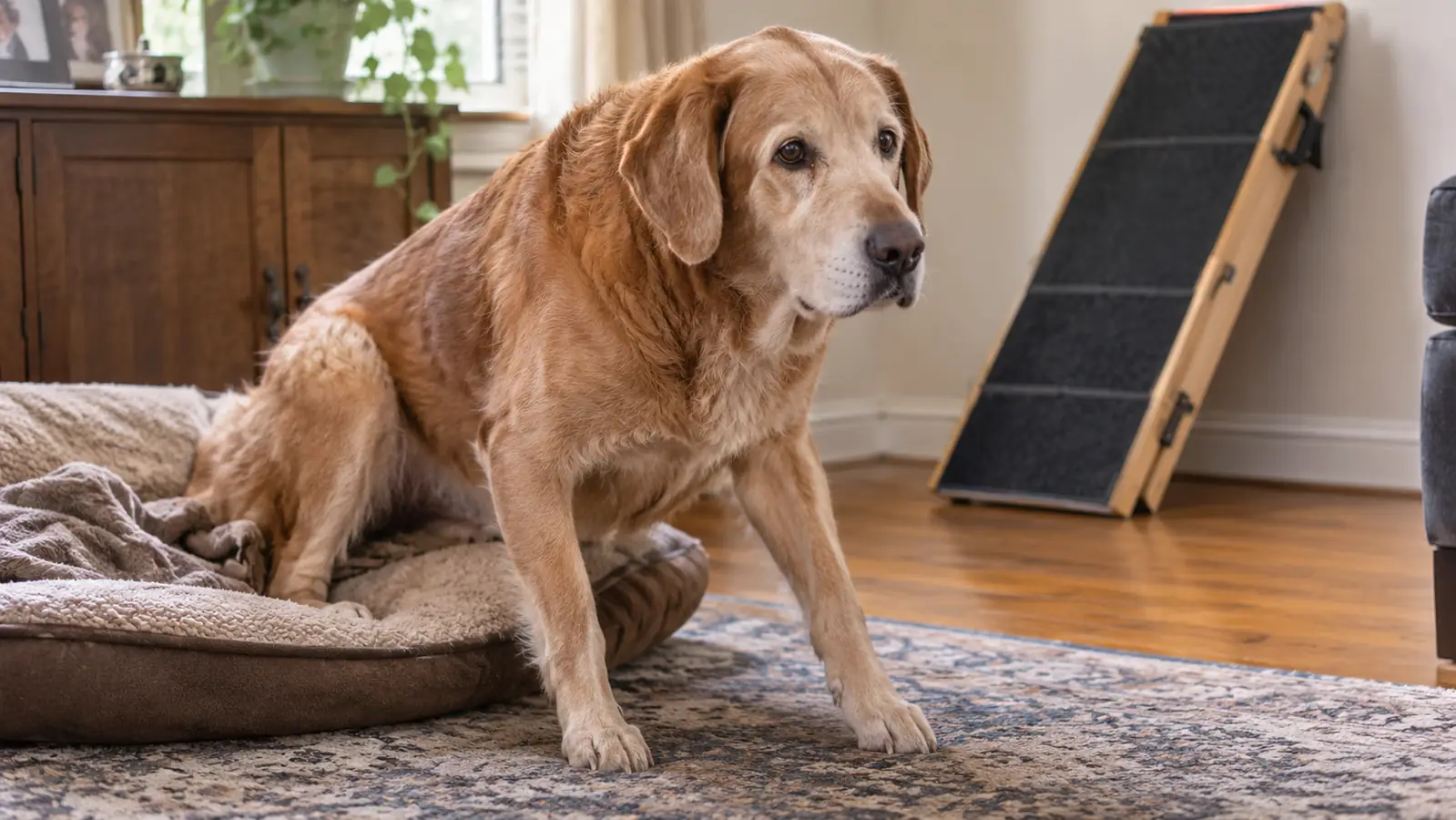
Cosequin is one piece of a routine and on its own it would not be enough. Moose sleeps on an orthopedic bed in the living room corner now, and the difference between that and the flat old cushion was immediate rather than gradual. On rough mornings he wears a lift harness for the two back-porch steps so I can take weight off his back end. The ramp stays folded in the garage and goes against the truck for every trip. The socks come out in the evenings on the hardwood. The supplement sits underneath all of it.
My order of operations, if you are starting from nothing: fix the floor, the sleeping surface, and the truck first. Those give you an answer inside a week. Cosequin gives you an answer in two months. A dog sliding on tile does not need a tablet, he needs a rug. A dog refusing the truck does not need a tablet, he needs a ramp. The supplement is for the part equipment cannot fix, which is the joint itself.
Weight is the other half of it. My vet was blunt about this one. Every extra pound on a Lab with hip arthritis is another pound landing on a joint that is already unhappy. Moose is leaner at ten than he was at seven, and I think that did as much for him as anything in the bottle. Keep the dog lean, keep him moving, and let the supplement support it. The order matters more than the brand.
I also take him in for a checkup every year now instead of every other year, and I bring the notebook with me. That is worth doing whether you use this chewable or not. Your vet can feel things through the hip that you cannot see from the back porch, and a written record of how the dog has been moving makes that visit more useful than a five-minute memory of last Tuesday.
Who This Is For
This is for the owner of a large older dog with mild to moderate stiffness, the kind a vet has already looked at and called early arthritis, where there is no crisis, just a slow decline you are trying to flatten out. It is for someone willing to give a tablet every day for a couple of months and judge the result honestly at the end. If the floor, the bed, and the weight are already handled, this is a reasonable last piece to add.
Who Should Skip It
Skip it if your dog is lame, in obvious pain, or suddenly worse. That is a vet visit and possibly a prescription, not something you order from a listing. Skip it if you know yourself well enough to know you will not keep the schedule for two months, because you will pay for it, get nothing, and blame the product. Skip it if your dog has food sensitivities and you have not asked your vet about the chicken flavor. And skip it if you want something that works by Friday. Nothing works by Friday.
Two years in, the morning score is still a steady three
If you are going to try it, read the panel, buy the count that matches your dog, and give it eight weeks before you decide anything. That is the whole of my advice.
Amazon Check Today's Price on Amazon →