
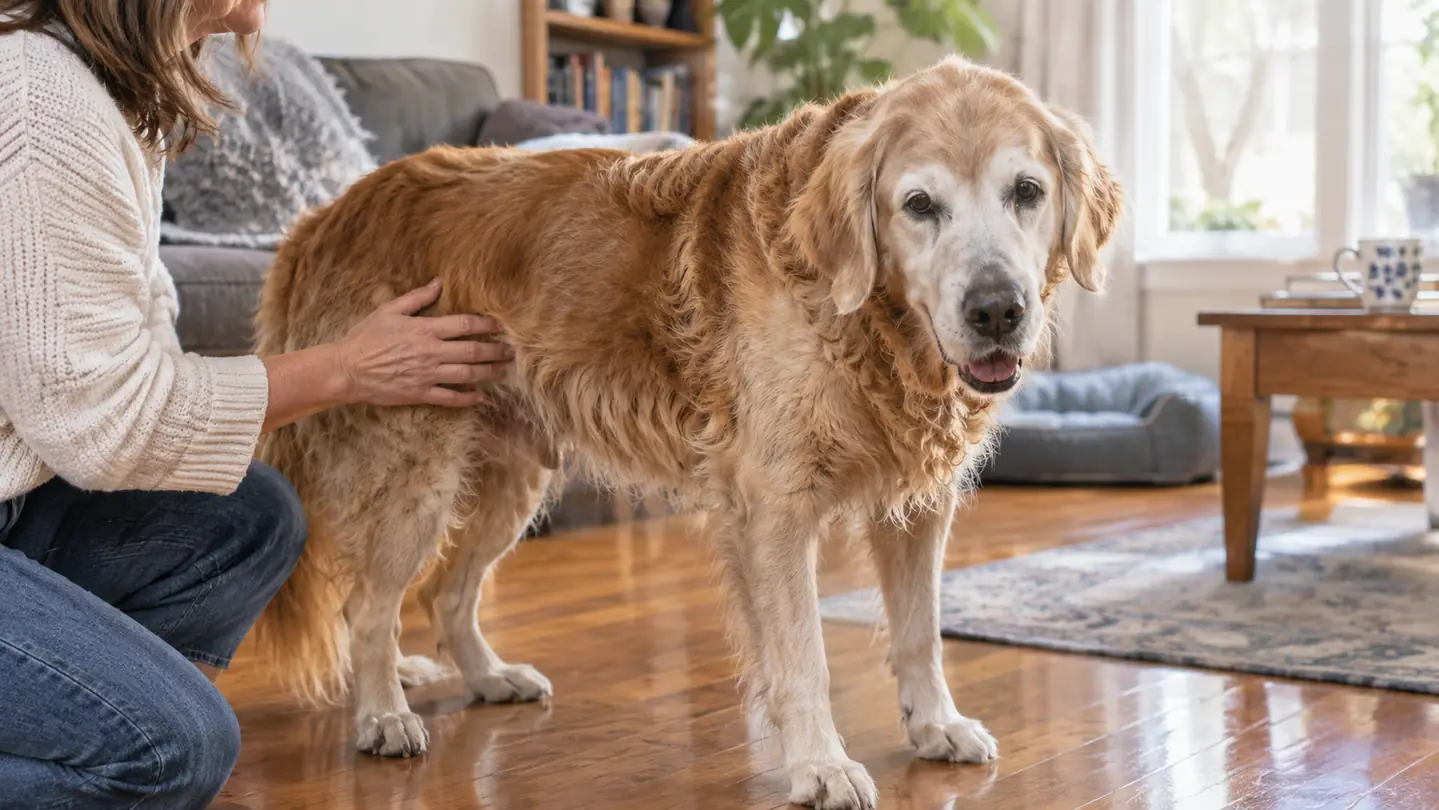
Hardwood is a poor match for an old Labrador. Moose is 10, about 82 pounds, and his back hips started getting stiff around age 8. The vet called it early hip arthritis and told me to keep him lean and keep him moving. Moving is the part that gets complicated when the floor gives him nothing to push against. He would stand up from his bed, take two steps, and scramble like a car with bad tires. I tried the obvious things first: keeping his nails trimmed and sweeping the floor so he was not sliding on dust. Then I put DOK TigerToes dog socks on him about five months ago. This comparison is about the other common option, Toe Grips, and which one makes more sense for a big senior dog.
Short answer: for a large senior dog that slips on hardwood and tile, I would start with DOK TigerToes. The sock covers the paw and puts grip under the whole foot, and the hook and loop closure gives you something to adjust. Toe Grips are the better choice only if your dog will not tolerate a sock, or if you need the least possible material on the paw. I have not owned Toe Grips. I looked at a set a neighbor uses on her dog, read the fitting instructions, and asked my vet about both. That is the honest limit of my experience.
| DOK TigerToes Dog Socks | Toe Grips | |
|---|---|---|
| Coverage | Fabric sock covers the paw, with grip built into the bottom and a hook and loop closure. | Small individual grips sit on the nails, leaving the pads bare. |
| Traction on slick floors | Grip is designed to keep working even if the sock twists. | Grip only helps where each nail contacts the floor. |
| Staying in place | Pull-on fit with hook and loop. On Moose they sometimes twist or slip and need adjusting. | No fabric to twist, but individual grips can work loose or come off. |
| Acceptance | Some dogs need several evenings to get used to a sock. | Much less material on the paw, so many dogs ignore them sooner. |
| Cleaning | Machine wash, per the label. | No fabric to launder. Grips are wiped or replaced. |
| Sizing | Large fits paws 2.5 to 2.8 inches. Four socks in the set. | Fit depends on nail size and trim, and each nail has to be fitted. |
| Best use | Hardwood, tile, and other slick floors. Listed for indoor and outdoor protection. | A dog that fights socks but will tolerate nail grips. |
| Large senior dog with hip arthritis | More grip under the whole paw without asking the dog to curl its toes. | Keeps the paw natural but gives less coverage. |
Where DOK TigerToes Wins
The first win is surface area. A sock puts grip under the pad and around the paw. When Moose stands at the back-porch steps, the whole foot has something between it and the hardwood. Toe Grips put a small cap on each nail, so the dog is still standing mostly on bare pads. On a slick floor, that is less rubber on the ground. The listing says the grip is designed to keep working even if the sock twists. In my house, that matters. Moose has had a sock twist after a nap, and the grip was still under his foot when he stood up.
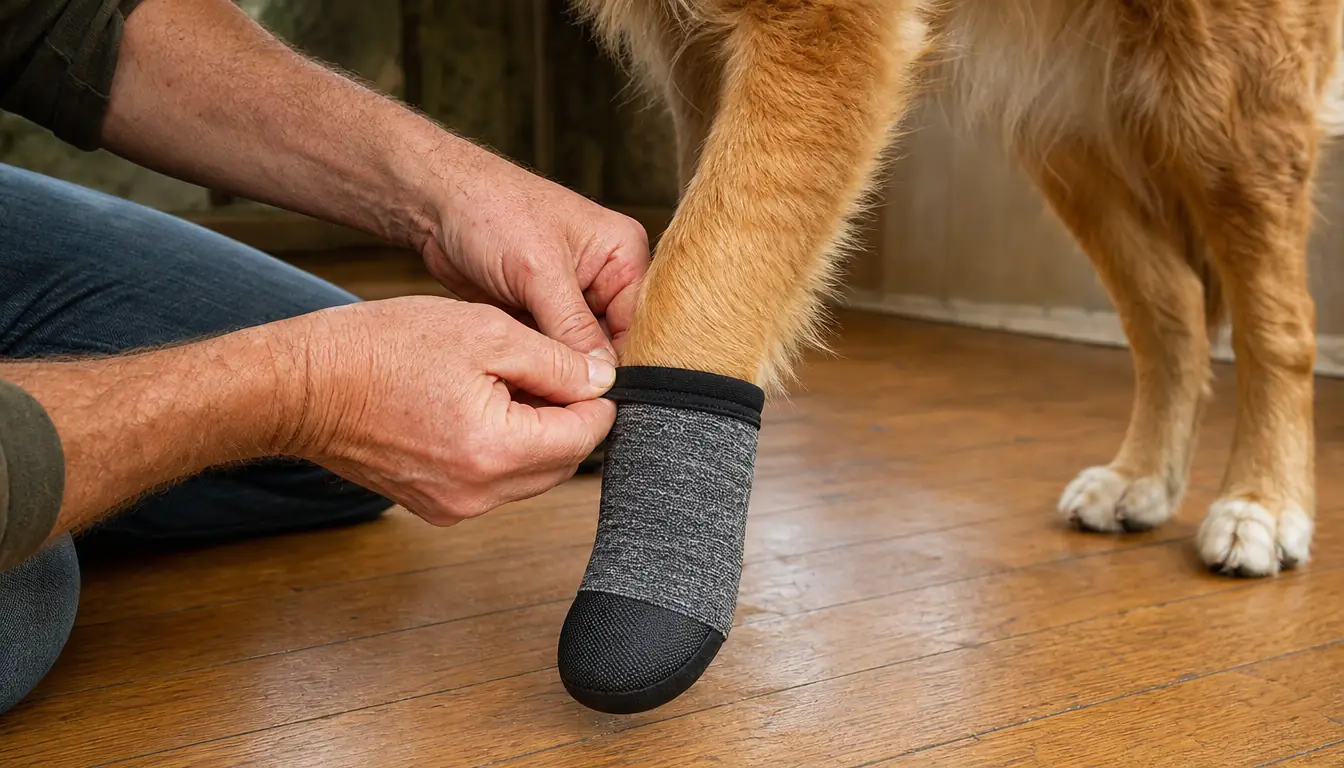
The second win is the closure. DOK uses a hook and loop strap plus a pull-on fit. That gives you a way to snug the sock without fighting a tight cuff over an old dog's paw. I have big hands and not much patience, and I can get all four on Moose in about a minute if he is lying down. The set includes four socks. The size Large is listed for paws 2.5 to 2.8 inches. I measured Moose's front paw across the widest part before I ordered, and that number was the difference between a sock that stays on and one that ends up in the hall.
The third win is that the sock does two jobs. It gives traction, and it keeps the paw off cold tile and rough spots. The label lists indoor and outdoor protection, though I still take them off for walks. Moose wears them in the evenings and on cold mornings. They are cotton and nylon and machine washable, which sounds like a small thing until you own a senior dog that leaks a little after a long nap. I wash them in a mesh bag and let them air dry.
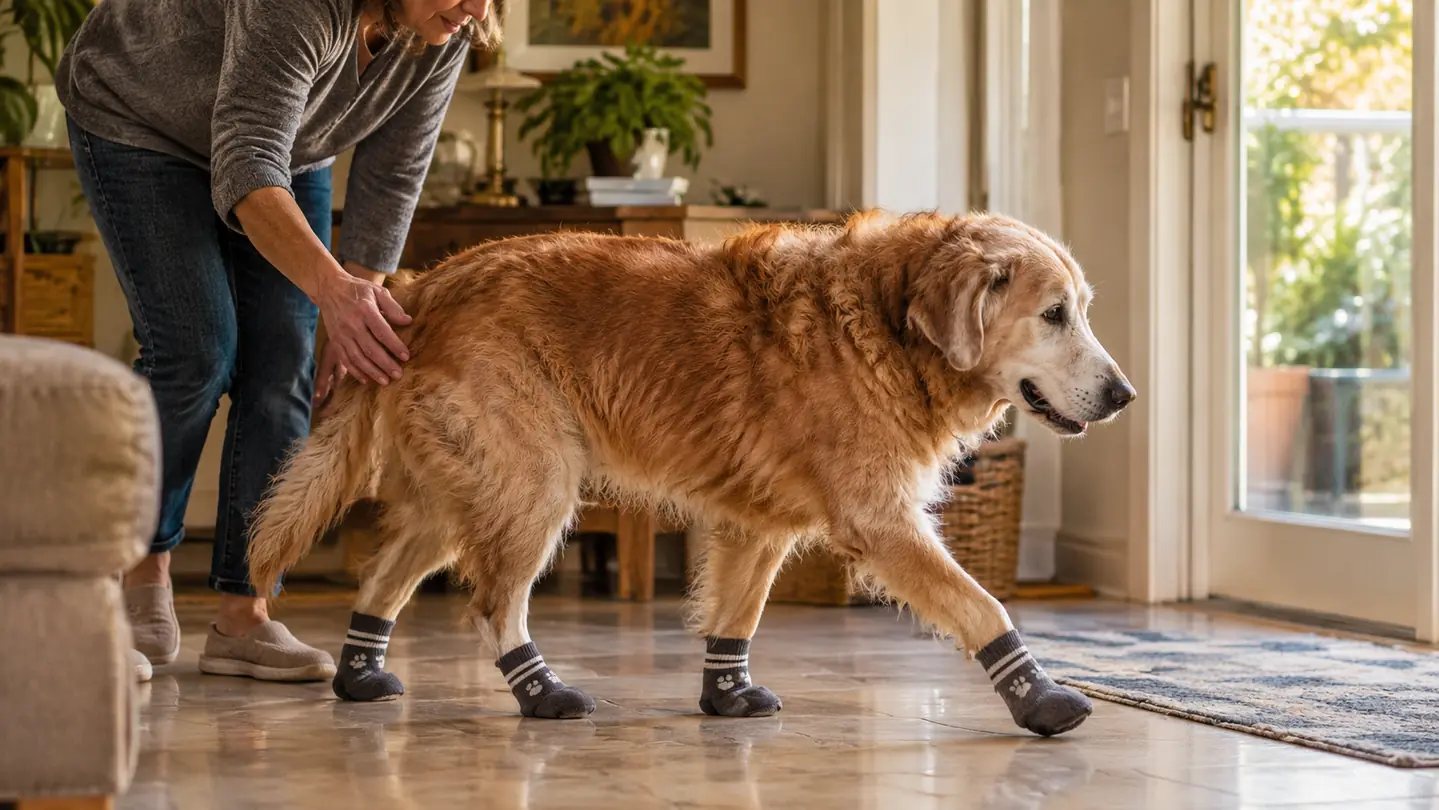
Here is the part I did not expect. Grip matters most when the dog turns, not when he walks a straight line. Moose can cross the living room fine on bare paws. It is the pivot at the end, when he swings his back end around to head for the water bowl, that his feet shoot out. The socks changed that. On the fourth evening I watched him do a full turn on the worn patch by the front door without a single slide, and then he stood there looking at me like nothing had happened. That patch is where the finish is gone. It is the slickest two square feet in the house, and it was the first place he stopped balking. That told me more than two weeks of notes.
Where Toe Grips Wins
Acceptance is the big one. A sock is a foreign object around the whole paw. Some dogs do what Moose did for the first three evenings: walk stiff-legged, stop, and try to shake it off. Toe Grips put much less material on the dog. The neighbor's dog wore them without the drama. If your dog panics at the sight of a sock, that difference is not small. A device the dog will actually wear beats a better device that stays in the drawer.
The second win is feel. Toe Grips leave the pads on the floor. For a dog that hates having its feet covered, or a dog that gets hot in socks, that is a real advantage. They also avoid the twisting problem. I have not seen a sock yet that stays perfectly straight on a dog that sleeps curled up. The DOK socks occasionally twist on Moose, and I have to reach down and straighten them. Toe Grips do not have a cuff to twist.
There is a third, narrower advantage. If your dog only needs a little more grip on the nails and will not keep a sock on, Toe Grips may be enough. I would not call them a better answer for Moose, because he is 82 pounds and his back end is the problem. But I can see the logic for a smaller dog with good nails and a low tolerance for clothing.
I got a decent look at the Toe Grips themselves. The neighbor's dog is a stocky mix, maybe 45 pounds, and she had a set on her front paws when I was over there helping him move a water heater out of his garage. What I noticed is that you can see the nails doing the work. The grips sat on the tips, and her pads were flat on his tile. She moved normally across the kitchen. He said the first set lasted a few weeks before a couple worked loose and had to be replaced. That is not a knock on the product, it is just the maintenance. Rubber wears, and a small rubber cap on a nail takes a beating from a dog that turns a lot on concrete.
If the floor is the problem, cover the whole paw, not just the nail
DOK TigerToes come as a four-sock set. Size Large fits paws 2.5 to 2.8 inches, with a hook and loop closure and a machine washable cotton and nylon build.
Amazon See the DOK TigerToes Sock Set on Amazon →How I Tested the DOK Socks at Home
I put the DOK socks on Moose for the first time on a Tuesday evening in the living room. The hardwood there is old and slick, especially where the finish has worn. I did not put them on and call it a test. I used them the way I actually live: after dinner, before bed, and on cold mornings when the tile by the back door feels like ice. I watched how he stood up from his bed, how he crossed the room, and whether he would go down the two back-porch steps with them on. I kept a notebook for the first two weeks, then stopped because the pattern was clear.
The first three evenings were not smooth. Moose did the stiff-legged walk, stopped in the middle of the kitchen, and lifted one back foot at a time like he was checking whether the floor was still under him. On the second night he worked a front sock loose by dragging it across the rug by the coffee table. I tightened the strap, told him he was being ridiculous, and he left it alone. By the fourth night he quit noticing. I still put them on the same way every time, back feet first, because he is steadier on the front end and less likely to sit down on me halfway through the job.
What I found is not dramatic. The socks did not turn Moose into a puppy. He still takes his time standing. He still needs the harness on bad mornings for the porch steps. What changed is the scrambling. Before the socks, his back feet would slide out from under him when he turned on the hardwood. With the socks, he gets a bite on the floor. He is less hesitant to cross the kitchen. That is the whole job. If you are looking for a cure for arthritis, this is not that, and no sock is.
The limits are real. The socks can twist. They can slip off if Moose drags a back paw getting up. I check them before he walks across the room and straighten them when needed. I take them off for outdoor walks because I do not want him wearing them through wet grass and gravel. The label lists outdoor protection, but my routine is indoors. If your dog is a chewer, watch him the first few times. A sock is fabric, and fabric is not a chew toy.
The socks did not make Moose young again. They stopped his back feet from sliding out from under him on the floor he walks every day.
The Tradeoffs I Live With
The biggest tradeoff is that DOK socks are gear, not a set-and-forget fix. I have to put them on, take them off, and check the fit. On a bad morning, Moose does not want to stand still for it. I kneel on the floor and put them on while he is lying down. If your dog will not lie still, this will be a two-person job or a no-go. Toe Grips have their own fuss, because each nail has to be fitted. The difference is that a sock has four pieces to manage and a nail grip has more.
The second tradeoff is that a sock covers the paw. That is good for traction but not always good for a dog that runs hot or hates the feel of fabric. Moose tolerated it after a few evenings, but he is a laid-back dog. If yours is not, the less material option may win by default. I would rather see a dog wear Toe Grips than wear nothing because the socks turned into a fight every night.
I also had to learn to keep track of the things. Four socks in a set sounds like plenty until one disappears under the couch for a week. I keep a small plastic bin on the shelf by the back door, and the socks go in there the moment they come off. When they get grubby I run them in a mesh laundry bag with a load of towels and let them air dry on the counter. The label says machine wash, and I have not had one come apart yet, but I am not going to put them in the dryer just to find out.
Who Should Buy Which
Buy DOK TigerToes if you have a large senior dog that slips on hardwood or tile and will tolerate a sock for a few evenings. It makes the most sense if the back end is weak, if the dog scrambles when it turns, and if you want grip under the whole paw. It also makes sense if you want something machine washable and easy to adjust. Size Large is listed for paws 2.5 to 2.8 inches, so measure before you order. If your dog is between sizes, ask the seller before you guess.
Buy Toe Grips if your dog fights socks, panics at the sight of fabric on its feet, or overheats easily. They are also worth a look if your dog has decent nails and only needs a little more bite on the floor. I would not buy them for a heavy dog with weak hips without talking to your vet first, because the nail carries the grip and the pads still do the work. If your dog drags a back paw or has long nails, ask your vet or a groomer to check the fit. A bad nail grip is worse than no grip at all.
The pair I keep by the back door
Moose still uses his harness on the porch steps and his ramp for the truck. The DOK socks are the piece that handles the hardwood and tile inside the house. If your dog is sliding on the same kind of floor, start there.
Amazon Check the DOK TigerToes Sock Set on Amazon →