
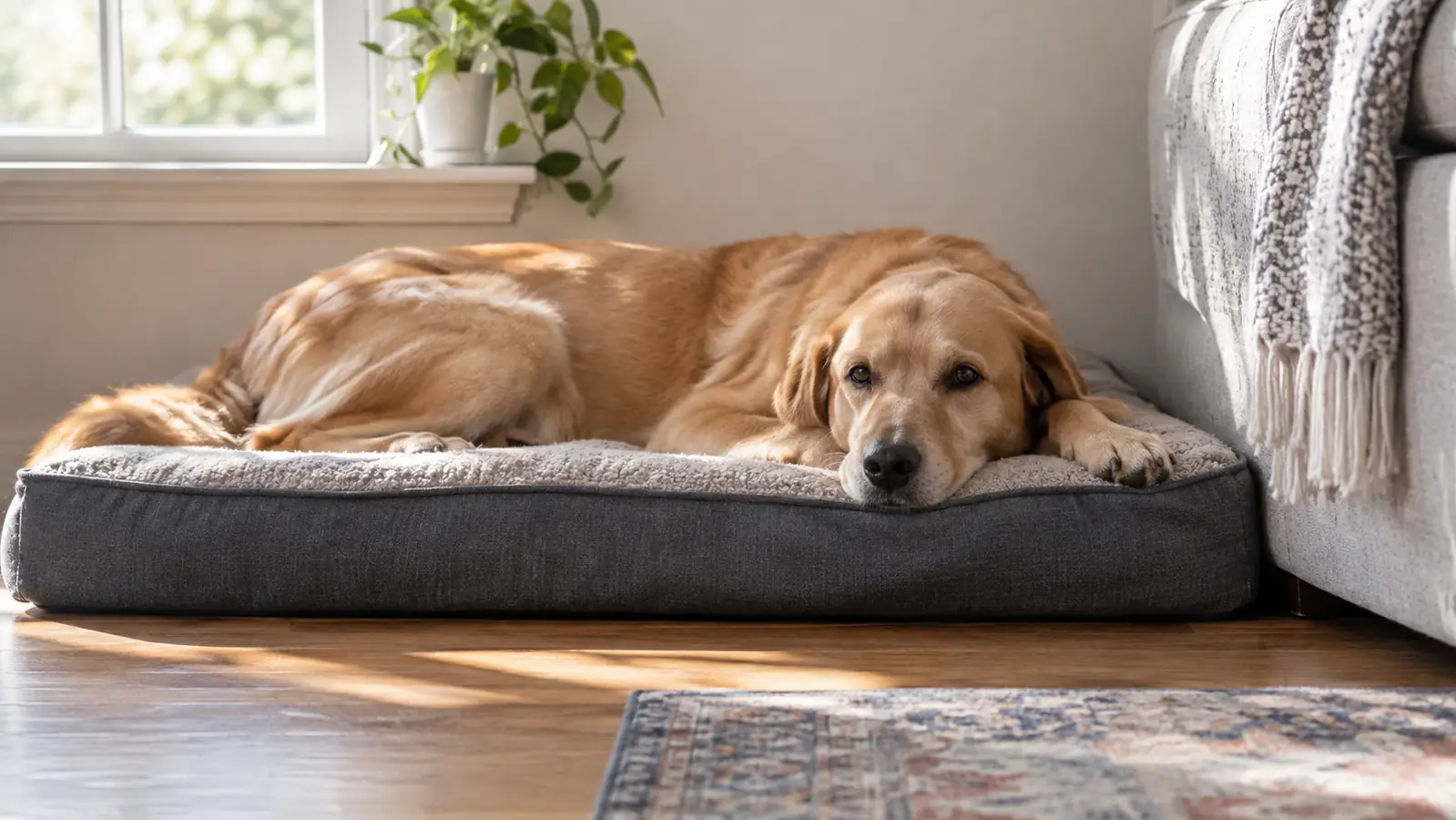
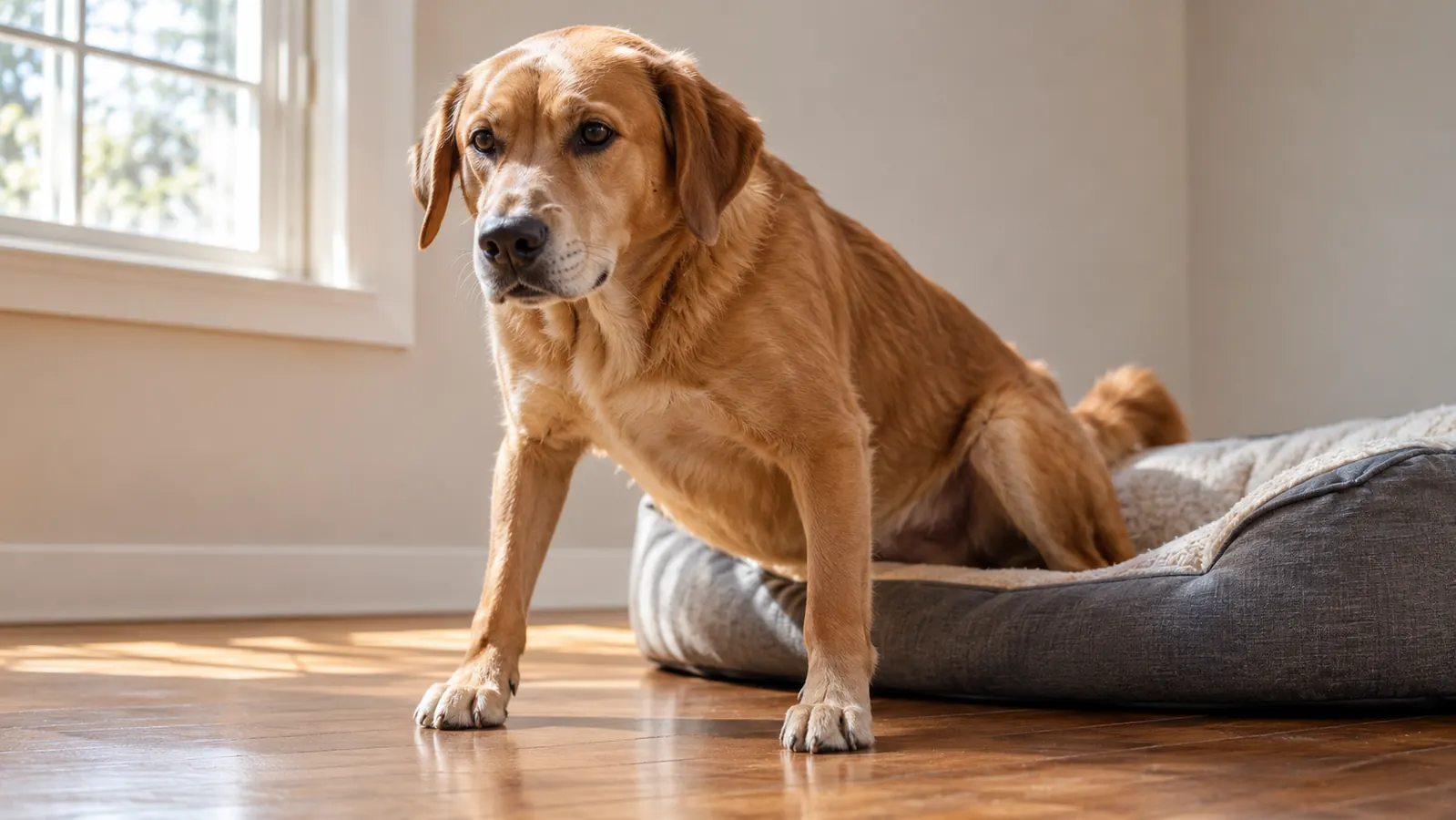
Moose is ten, an 82 pound yellow Lab, and he does this thing when he gets up from a nap. He rocks forward twice before his back end comes off the floor. The first rock is him deciding. The second is him committing. Two years ago he just stood up, one motion, no negotiation, and I did not think about it once.
I am not a vet. I am a retired auto mechanic outside Sacramento, and I fix things by working out which part is actually failing before I buy a replacement. At Moose's age-eight checkup the vet told me he had early hip arthritis and that the plan was to keep him lean and keep him moving. He did not hand me a shopping list. What he did say, when I asked about the flattened old cushion Moose had slept on since he was a puppy, was that a dog with sore hips needs a surface that gives back some of the height he loses when he lies down. That is what sent me to an orthopedic bed, and after about fourteen months on the JOYELF XL memory foam bed in the corner of my living room, here is my honest read: the bed is maybe a third of the job. The rest is where you put it, what you take away, and how you handle the first week.
A dog that stands up in one motion instead of two
The JOYELF XL measures 40.16 by 30.31 by 9.06 inches and is rated for extra large breeds up to 100 pounds. Solid memory foam base, removable cover you can wash. It is what Moose has slept on for about 14 months.
Amazon Check Today's Price on Amazon →What follows is the order I would do it in if I were starting over. I did steps three and four backwards the first time and lost about five days because of it.
Step 1: Measure the dog and the floor before you shop
Two numbers matter. The first is your dog's lying-down length, roughly from the base of the neck to the base of the tail, plus about six inches of slack so he can stretch out flat instead of curling into a ball to fit. Moose is a shade over 40 inches nose to tail and about 34 stretched out, and he is a full grown male Labrador at 82 pounds. The second number is the floor space you are actually willing to give up, which is usually smaller than people expect.
The JOYELF XL is 40.16 by 30.31 by 9.06 inches and the listing rates it for extra large breeds up to a maximum recommended weight of 100 pounds. That rating is the number to read twice, because a bed rated to 100 pounds and an 82 pound dog with sore hips are not the same problem. Moose sits inside the rating with room to spare, and that is the whole point. A dog that loads his front end when he stands needs the foam to still be foam under his back end at month fourteen, not at month one.
Then measure the floor, not the room. The bed wants one long side against a wall or the arm of a sofa so it stays where you set it. A bed that shifts every time the dog steps on it gets avoided, and a dog that avoids the bed is back on the hardwood. Moose's sits in a corner with the long edge against the wall and the short edge against the sofa. It has not moved since the day I put it there.
Step 2: Put it where he already sleeps, not where you want it
This is the mistake I made for the first three nights. I put the new bed in my bedroom, because it was out of the way and it looked tidier there. Moose slept on the bare floor next to it twice and looked at me like I had lost the plot. Then I moved it to his corner by the sliding door, the spot he had claimed as a puppy, and he was on it before dinner.
My house is hardwood and tile, which is close to the worst floor you can give a dog with sore hips. He slips on it. So placement is also about the path to the bed. He should be able to reach it without crossing a slick runway and making a turn at the end. In the living room corner he steps off the rug and he is on the bed. In the bedroom he would have crossed eight feet of shiny oak and then pivoted on it, which is exactly the movement that makes him hesitate.
One bed, one spot. I know people who bought two, one upstairs and one downstairs, and the dog picked a favorite and ignored the other entirely. If your dog already has a chosen place to lie down, that place is your answer. Move the furniture, not the dog.
Step 3: Retire the old cushion the same day
The old cushion is not a neutral object. It is a couple of pounds of his own smell and several years of habit, and a pad compressed down to an inch still feels like home to him even while it is failing his hips. If you leave it in the room, he will choose it. Not because it is better, but because it is his.
When I set the JOYELF down in the corner, I carried the old cushion out to the garage that same afternoon. Not folded in the closet, not stacked under the new bed for padding, out of the room. That is the entire step and it is harder than it sounds, because for one evening Moose stood in the corner looking at the floor where the cushion used to be, and I felt like a man who had thrown out his dog's furniture.
You can ease the changeover. Put a worn t-shirt of yours on the new bed for the first two nights. Smell is most of what a dog is deciding about, and your smell on a strange surface turns it from strange into his.
Step 4: Spend a week teaching him the bed is safe
Two rules. Do not lift him onto it, and do not trap him on it. If you pick up a dog with arthritic hips and set him down on an unfamiliar surface, you have taught him that the surface is a thing that happens to him. He will fight you the second time, and he will be right to.
Lead him instead. A treat on the bed. Then a treat on the bed again. Then a hand flat on his chest and a treat set down between his front paws. Moose took about ninety seconds the first time and then got off after four minutes, which is completely normal. Short rests first. Do not close a door, do not block the exit, do not hold him in place to prove a point.
Then watch the getup. This is the part most people skip, because lying down is easy for a sore dog and it looks like success. Lying down is not the measurement. Standing up is the hard part, and standing up is the only thing the bed is really for. Before the orthopedic bed Moose did the two-rock stand I described at the start, a false start and then the real one. Two weeks in, he was doing it in a single motion about half the time. Half. That is what I actually noticed, and it is worth more than it sounds like.
Lying down is easy for a sore dog. Standing up is the hard part, and standing up is the only thing the bed is really for.
Step 5: Keep the foam working past the first month
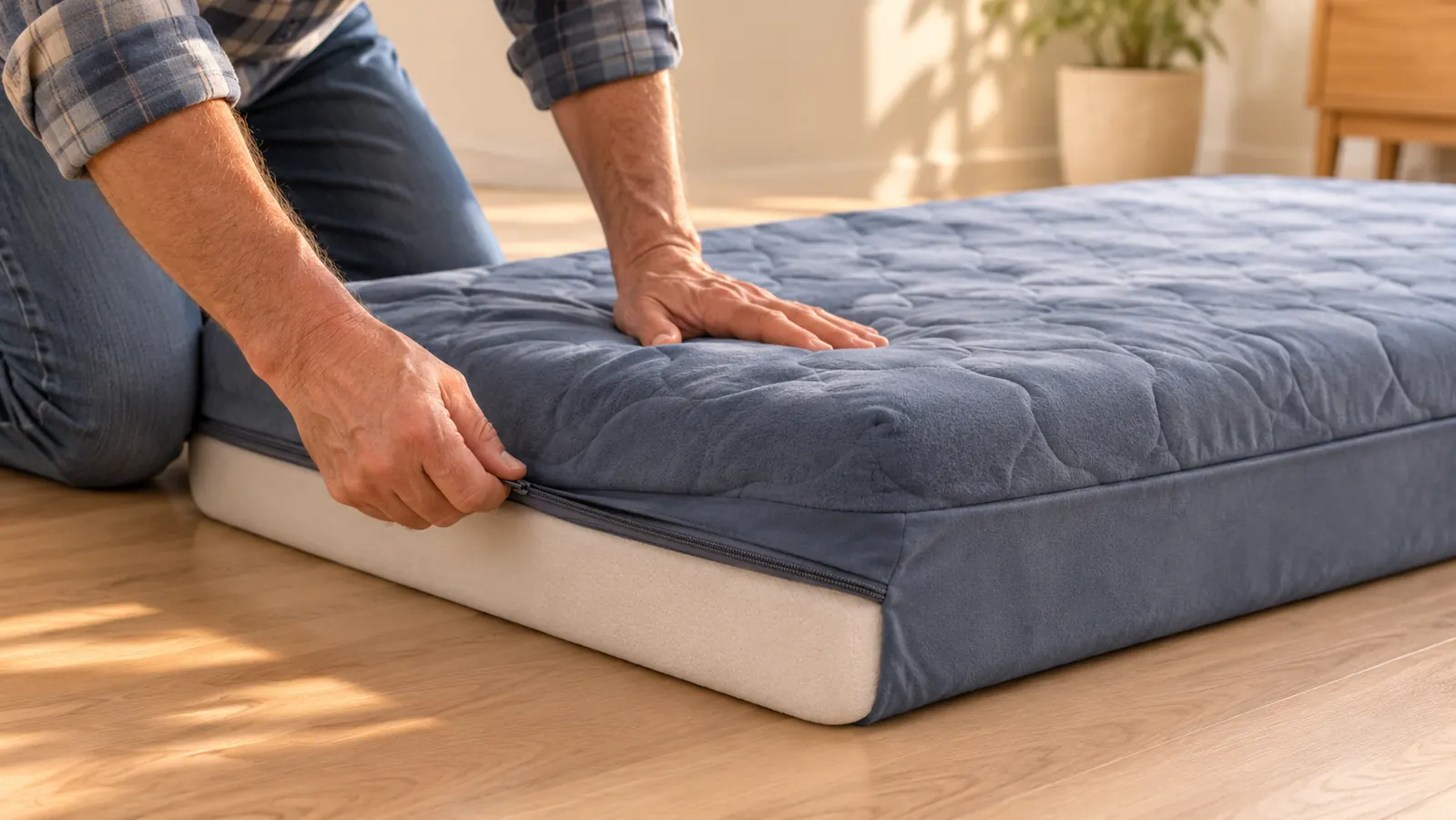
A memory foam bed does not fail all at once. It fails under one hip. The cover on the JOYELF is removable and machine washable, and I run it through every few weeks, partly for the hair and partly because a dog that can smell himself on a clean bed uses it more willingly. Take the cover off, zip it shut before it goes in, and follow the tag. The foam core never goes in the machine, no matter how tempting the shape of it looks jammed in there.
Once a month, press the foam flat with your hand where his hip lands. It should push back at you. When it stays dented for a few seconds after you let go, the bed is losing the one job you bought it for. Mine is at about fourteen months and the foam under his left hip, the bad side, is noticeably softer than the right. That is expected wear, not a defect. I have started turning the bed head to foot every couple of months so he is not always loading the same patch of foam.
Here is my rough rule, and it is a rule of thumb and nothing more. A large dog who uses an orthopedic bed every day, all day, gets somewhere around eighteen months to two years before the foam has taken enough of a set that I would replace it. It is not a lifetime purchase. Nobody should tell you it is, and the price on the listing is not the number that matters next to a dog that cannot get comfortable.
What Else Helps
The bed is a rest surface. It is not a treatment, and it does not make up for the rest of the plan. I want to be clear about that before anybody reads this as a fix for a medical problem.
Weight comes first. My vet's actual instruction at the age-eight checkup was keep him lean and keep him moving, and every pound off an 82 pound Labrador takes load off hips that are already arthritic. Moose gets measured food and fewer biscuits than he would prefer. That one costs nothing and it has done more for him than anything I have bought.
Traction is next, and people underestimate it. Hardwood and tile are the enemy in this house. In the evenings and on cold mornings Moose wears non-slip socks indoors so his feet do not slide out from under him when he turns. They twist off sometimes and I put them back on. He does not wear them outside, and he does not wear them on the bed.
Then the handling gear for the parts of the day that are not resting. He has a lift harness I use under his back end for the two steps off the back porch on bad mornings and for slick spots, and a folding ramp that lives in the garage and gets set against the rear cab door of the 2014 F-150 on every trip to the park or the vet. Before the ramp, I lifted him into the truck by hand, which at 82 pounds is a younger man's job. He needed about two weeks of treats before he trusted the ramp, and now he walks up it like he built it.
And he has been on a joint supplement since that same checkup, one tablet split into his breakfast, with a change I noticed gradually somewhere around week six. That is the daily baseline underneath everything else. If your dog is limping, dragging a back foot, or yelping when he stands, that is a vet appointment and not a bed purchase. A bed is what you sort out after the vet has told you what you are dealing with.
If you are going to do one thing this week, do it in this order: measure the dog, move the bed to his corner, carry the old cushion out to the garage, and leave him alone with it for a week. That sequence is the entire method. The bed is the easy part.
You cannot fix the hips. You can fix the surface he stands up from.
40.16 by 30.31 by 9.06 inches, solid memory foam base, rated to 100 pounds, removable washable cover. One bed, one corner, one week of patience.
Amazon See the JOYELF Orthopedic Bed on Amazon →