

I am not a vet, and I am not going to pretend a chewable tablet is a cure for a ten-year-old yellow Labrador with arthritic hips. My dog Moose is 82 pounds, ten years old, and was diagnosed with early hip arthritis at his age-eight checkup. The vet gave me two things I could control: keep him lean and keep him moving. A daily joint supplement went into the plan after that. Nutramax Cosequin is the one Moose has taken since that appointment, about two years now.
What follows is the routine I use, in the order I use it. It is not a treatment plan for every dog. It is what a retired mechanic does when something in the house starts to wear: find the actual problem, write down what changes, use the right part, and stop guessing. If your senior dog is stiff, the sequence matters more than the bottle.
Get the stiffness checked before you buy another joint chew
Cosequin is daily joint support, not a pain pill. My vet confirmed Moose's hip arthritis first, then we added Nutramax Cosequin to his breakfast. If your dog has not been examined, start there. If your vet says joint support makes sense, this is the product Moose has taken for about two years.
Amazon Check Today's Price on Amazon →Step 1: Get the stiffness checked before you buy anything
The first thing I did was not buy a supplement. I loaded Moose into the back seat of the F-150 and had the vet look at him. He was slow to stand after a nap, he hesitated at the two steps down from the back porch, and he had stopped jumping into the truck bed on his own. Those signs can mean several things. The vet moved his hips, watched him walk, and gave me a diagnosis I could work with. Early hip arthritis. That was at age eight. He was not yelping. He was not lame. He was just slower, and slow is easy to ignore until it is not.
I am not a vet. I fix cars. So when I say get a checkup first, I mean it. A supplement can support a joint, but it cannot tell you why a dog is lame. If your dog yelps, drags a leg, stops eating, or goes off his back end suddenly, that is a vet call, not a shopping decision. The exam also gave me a baseline. I knew what we were dealing with before I changed anything. The vet also watched him walk and get up, which I would not have thought to do.
The vet also told me to keep Moose lean and keep him moving. That advice has done more than any single product. Cosequin went into the routine after that, not before it. I am not going to sell you a bottle as a substitute for an exam, and you should be suspicious of anyone who does. The exam took a morning and gave me a plan. That is a better trade than guessing at supplements for six months.
Step 2: Write down what stiff looks like on your dog
I started keeping notes because I am bad at remembering whether something is better. I wrote down how long it took Moose to stand after a nap, whether he cleared the porch steps without a pause, and how far we walked before he slowed. I also took a short video on my phone once a week, same hallway, same time of morning. That video was more honest than my memory. I kept the notes on the same counter where I drop my keys, so I would actually see them.
Stiffness is easy to see and hard to score. 'He seems better' is not useful. 'He stood up on the first try in under five seconds' is. I kept a simple note on the counter. Date, morning stiffness, steps, walk length, and anything else that changed. If you try Cosequin, you need a before picture, or you will credit the supplement for a good week and blame the weather for a bad one. Weather matters too. Damp mornings are worse for Moose, and I note that so I do not confuse a cold snap with a supplement failure.
Your list does not need to be fancy. A text to yourself works. The point is to compare the same things over time, not to build a medical chart. Your vet can use it too, and it is a lot more helpful than trying to remember how your dog walked three weeks ago. If you have a phone, use the camera. A ten-second clip of your dog rising from a nap tells you more than a paragraph of description.
Step 3: Start Nutramax Cosequin the way the label says and keep it boring
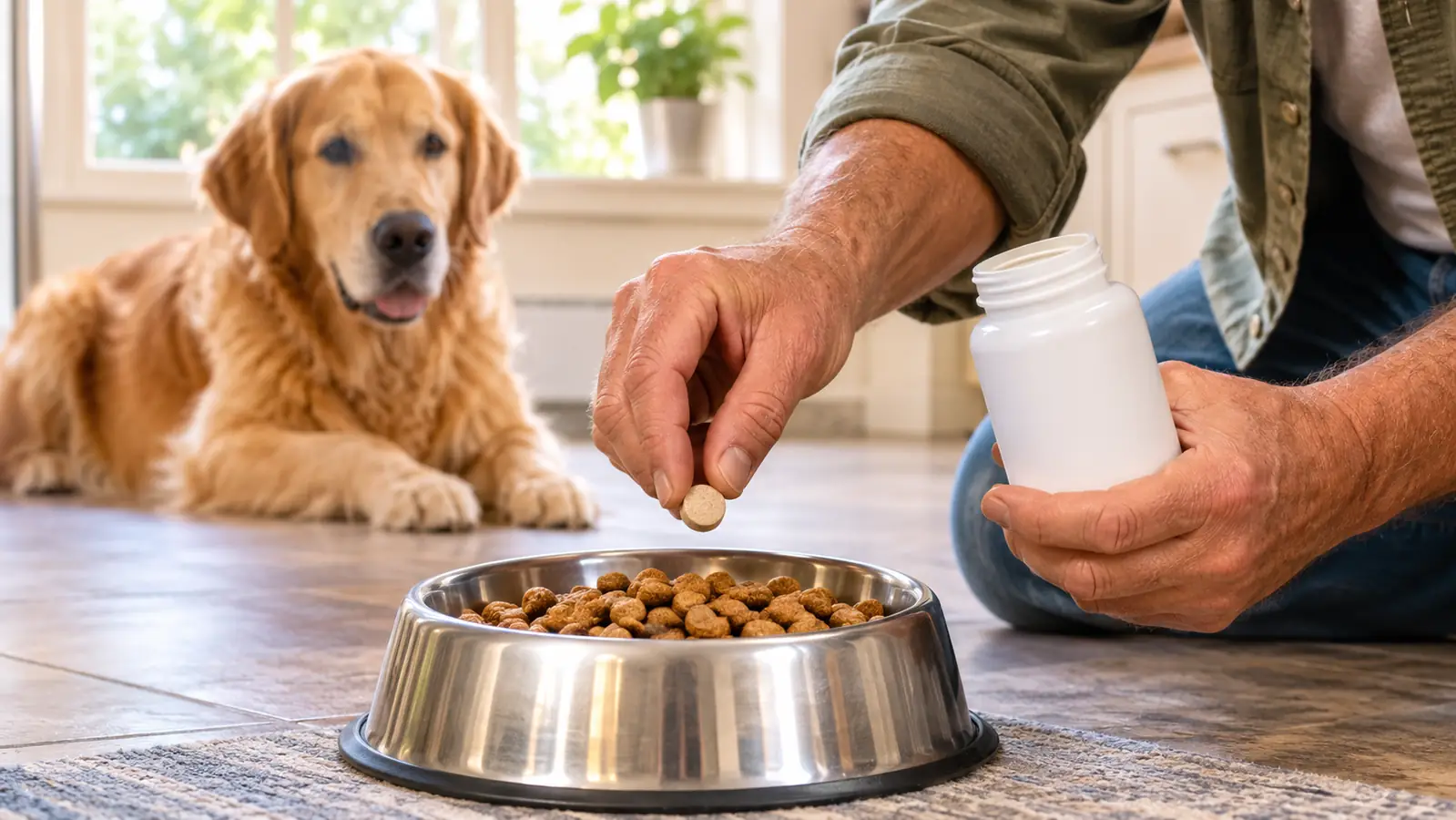
Moose takes the chewable tablets. The label lists glucosamine hydrochloride 600 mg, sodium chondroitin sulfate 300 mg, and MSM, and the tablets are chicken flavored. The bottle I buy is the 60 count. I give him the amount my vet confirmed for his weight, split into his breakfast. That is the whole ritual. No extra tablets because he had a bad morning, no guessing at a bigger amount. I keep the bottle out of reach of the dog, which sounds obvious until you own a food-motivated Lab.
The mistake I see people make is treating a joint supplement like a pain pill. Cosequin is daily joint support. It is not going to make a dog with a torn cruciate walk normally, and it is not a substitute for a diagnosis. What I noticed with Moose was gradual. Around six to eight weeks in, his morning starts were easier. Not a jump, not a run, just less of the slow, careful stand. That is the kind of change this product is suited to, and it is why I kept going. I also did not change his food, his walks, and his bed all in the same week. If you change five things at once, you learn nothing.
Consistency matters more than anything. A chewable tablet only helps if it goes in the dog. Moose is food motivated, so the chicken flavor goes down in his breakfast without a fight. If your dog is picky, do not force it and do not guess at a higher amount. Ask your vet about the right form and amount. The 60-count bottle sits on my counter, and I check the label every time I open a new one, because directions can change and I would rather read than assume. The chicken flavor is the only reason this is easy in my house. A dog that turns his nose up at a tablet is a dog that will not get the benefit.
Around six to eight weeks in, Moose's morning starts were easier. Not a jump. Not a run. Just less of the slow, careful stand.
Step 4: Take the daily load off the joints while the supplement does its job
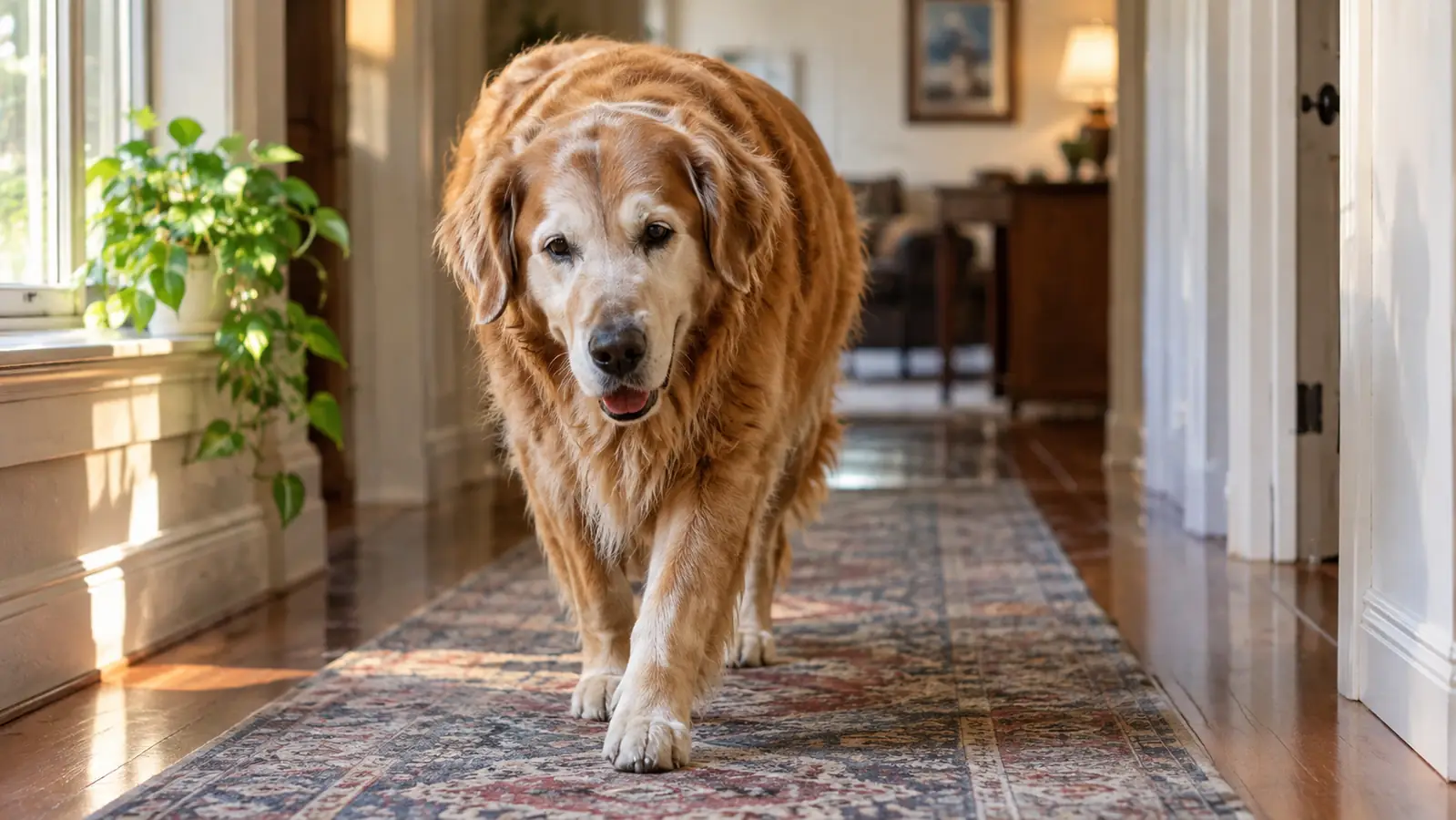
A supplement is one part. The floors, the steps, the truck, and the dog's weight are the rest. My house has hardwood and tile, which is slick for an old Lab. Moose was scrambling to get up, and every scramble is a bad repetition. I put down a runner in the hallway and a mat where he turns. That is not a product endorsement. It is just less slipping. I also wiped up water by the bowl. A wet tile floor is a skating rink for a dog with bad hips.
When Moose hesitated at the two back-porch steps, I started using a lift harness on bad mornings. Not to haul him around, just to steady his back end. For the truck, I use a folding ramp. Before that, I lifted him in by hand, and my back did not enjoy it. The ramp took a couple of weeks of treats before Moose trusted it. Now it stays folded in the garage and goes against the rear cab door for park trips and vet visits. The harness is for steadying, not for lifting him like a suitcase. I put it on, take his back end, and let him do the steps at his pace.
The other piece is weight. The vet told me to keep Moose lean. I weigh his food and I do not free-feed. An 82-pound Lab does not need to carry extra pounds up a hill. I also keep the walks steady. Short and regular beats a big weekend hike. If your dog is stiff, do not turn exercise into a test. Flat ground, easy pace, and let the dog set the distance. I keep his nails trimmed too. Long nails change how a dog stands, and I would rather fix the easy stuff first. A vet once told me that a lean dog with arthritis often moves better than a heavy dog with the same hips. That stuck with me.
Step 5: Recheck at six to eight weeks, then let your vet adjust the plan
I did not judge Cosequin on day three. I gave it a fair stretch, kept my notes, and looked at the pattern. For Moose, the change showed up around six to eight weeks. If you see nothing by then, that is useful information. It does not mean you failed. It means you should talk to your vet about what else is going on, because stiffness can come from the hips, the knees, the spine, or the feet, and a supplement is not a diagnosis. I marked the date on the calendar so I would not keep moving the goalposts.
At the recheck, bring your notes and the bottle. Tell the vet exactly what you are giving and how much. I am not a vet, and I do not want to pretend that a garage routine replaces an exam. The vet can tell you whether to continue, stop, or change course. Moose stayed on Cosequin because his checkups stayed stable and his morning stiffness was better. That is our result. Your dog may be different. I also asked whether his weight was where it should be. That is a conversation, not a number I make up.
One more thing. If your dog gets worse, stops eating, or has a bad reaction, call the vet. Do not wait for the eight-week mark because a blog told you to. A how-to article is not a medical chart, and I am just a guy with one dog and a truck. The same goes for any supplement. If something changes for the worse, the bottle is not the boss of you. I would rather look dumb asking a question than smart with a dog that is worse.
What Else Helps
Joint support is a stack, not a single bottle. The things that helped Moose most were boring: a bed that let him get up without a struggle, traction on the slick floors, a ramp for the truck, and a harness for the porch steps. The bed is in the living room corner. The socks go on in the evenings and on cold mornings. The ramp lives in the garage. None of it replaces Cosequin. It just makes the daily routine easier on him. The bed replaced a flat old cushion that had lost its shape. His get-up is less of a project now.
Keep the dog lean, keep the walks steady, and keep the floors dry. If your dog has trouble on stairs, block them or carry him if he is small enough. If he is too heavy to carry, use a harness and get help. Do not let a stiff dog launch off the couch because it is easier for you. The goal is to reduce the bad landings, not to wrap the dog in bubble wrap. A tired dog will lie down more, and a dog that lies down more gets stiffer. Short walks are part of the treatment, not a bonus.
Ask your vet before you add anything else. I know people stack glucosamine, chondroitin, MSM, green-lipped mussel, fish oil, and CBD, and I am not going to tell you what to put in your dog. I can tell you that Nutramax Cosequin is the one I use, that it has the ingredients on the label, and that Moose has taken it for about two years. That is the limit of my experience. I am not anti-supplement. I am anti-guessing. There is a difference.
One honest note about the tablets. They are chewable and chicken flavored, but they are still a tablet. Moose takes his split into breakfast. If your dog spits it out, do not hide it in a whole meal and hope. Ask your vet about the best way to give it, and read the label. A supplement that ends up on the floor is not doing anything. I also do not leave the bottle on the floor. Moose is a Labrador. He will eat anything that smells like chicken.
The bottle I keep on the counter for Moose
Nutramax Cosequin chewable tablets, 60 count, chicken flavor. Moose has taken them daily since his age-eight checkup. It is daily joint support, not a pain pill, so get the diagnosis first and give it time. Ask your vet if you are unsure about the amount for your dog.
Amazon Check Today's Price on Amazon →