
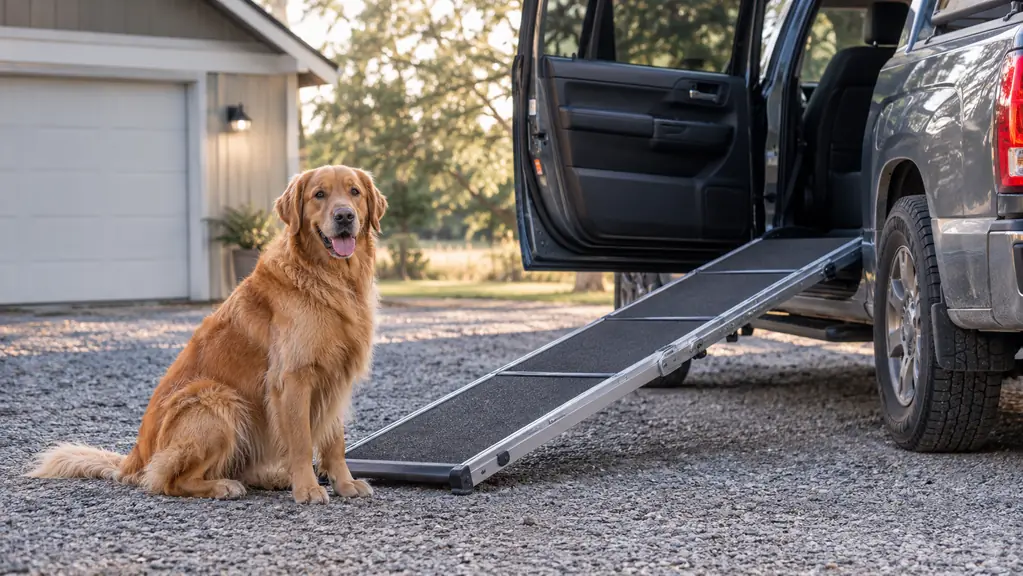
Moose is ten years old, a yellow Lab, and eighty-two pounds on the vet's scale. He can still walk a mile on a cool morning and he still brings the ball back, just slower than he used to. What he cannot do is climb into my 2014 F-150. He stands at the rear cab door, looks at the sill, looks at me, and waits. That look is the whole problem in one picture.
For about a year I lifted him in. Eighty-two pounds is not a hay bale, but it is not nothing either, and my lower back started filing complaints at the end of every park trip. Lifting him was not doing him any favors either. My vet told me at his age-eight checkup that Moose had early hip arthritis and that the job from here was to keep him lean and keep him moving. Hoisting a dog into a truck is the opposite of moving. It is a ride.
So I bought the PetSafe Happy Ride folding ramp about eight months ago. Ten pounds, sixty-two inches long, sixteen wide, rated for 150 pounds. It folds in half and lives against the garage wall. The ramp itself is simple and I have no complaints about it. The part that took work was everything around the ramp, and that is what this guide covers.
A ten pound ramp beats an eighty-two pound lift
The PetSafe Happy Ride folds flat, carries a 150 pound load rating, and hangs against the garage wall until the next vet trip. Moose needed about two weeks of treats to trust it. That was the only hard part.
Amazon Check Today's Price on Amazon →Step 1: Set the Ramp Up Before the Dog Is Anywhere Near It
Park level. Not the sloped driveway, not a crowned street where one tire sits low. A ramp that shifts under a dog's weight teaches him the ramp cannot be trusted, and that lesson sticks longer than any treat does. Put the dog in the house or have somebody hold him while you do this. You want the ramp settled and boring before he ever sees it.
The first time I set mine up, I did it in a hurry on the sloped apron in front of the garage because it was closer to where Moose was standing. It took me about ninety seconds to figure out the mistake. The ramp had a rock in it, maybe a quarter inch of travel, and Moose put one paw on and backed off like the thing had barked at him. I moved the truck out onto the flat gravel and gave it two days before I tried again. Do the flat ground first, every time, even when it costs you a minute of maneuvering.
Then open it and latch it. The PetSafe Happy Ride folds in half and has a safety release latch. Extend it fully, engage the latch, and set the four rubber feet flat on dry pavement. Push down on the top edge with your own hand before the dog is anywhere near it. If it rocks or walks, reset the feet and try again.
Angle is the part people skip, and it is the part that decides whether this works. The ramp is sixty-two inches long, so how far back you set the base from the door changes everything about the climb. Push the base out and the run gets longer and flatter. Pull it in and it gets short and steep. Steep means a dog with bad hips has to push his whole bodyweight up with his back legs, which is exactly the thing he cannot do anymore. Give him the shallowest angle the parking spot allows.
I measured mine the second week because I got tired of guessing. With the base pulled back so the top edge sits just under the door sill, the whole run is about five feet of travel from ground to floor, and the rise is a hair over two feet. That is the number I hold onto now. If I have to jam the base in close to the truck to fit in a parking space, I will move the truck instead, even if it means walking further to the trailhead.
Last, check the walking surface. The ramp has high-traction treads and side rails. Run your hand down it. If it is wet, gritty, or tracked with mud from the driveway, wipe it dry. The side rails only help a dog who is not already sliding.
Step 2: Let Him Inspect It Cold
Before the ramp ever touches the truck, lay it flat on the garage floor and leave it there. No coaxing, no patting the surface, no standing at the far end calling him. Moose's first reaction to anything new is to walk a wide circle around it and pretend he has not seen it.
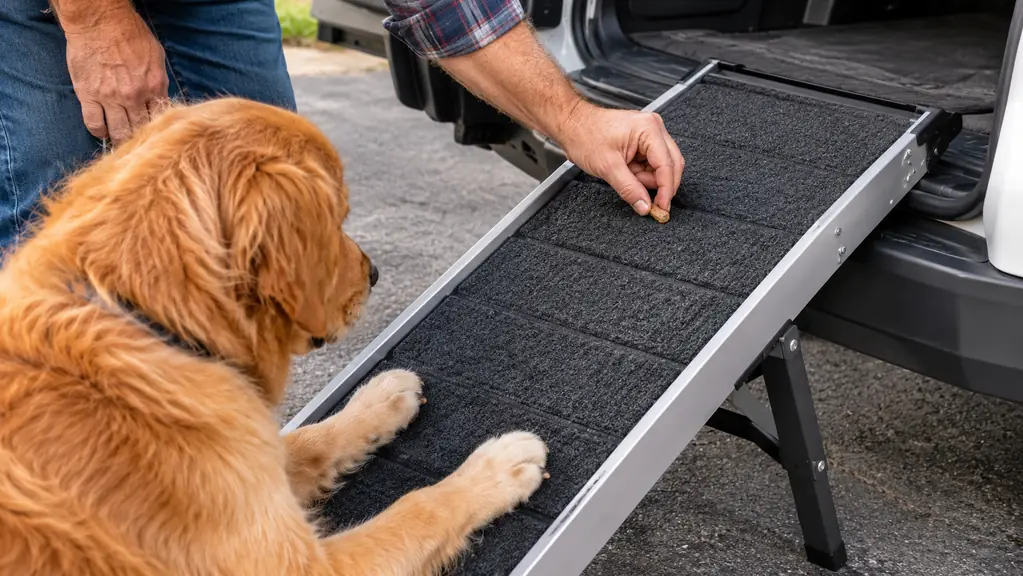
Put a few small treats on the ramp surface itself and walk away. Not in your hand. On the ramp. The point is for him to put his own nose, and then his own paws, on it while nobody is watching him do it. Then go do something else in the garage for ten minutes.
What I got wrong the first afternoon was standing there watching him. I had a pocket full of treats and a big encouraging voice and I was basically performing. Moose would not come within six feet of it. I went and sorted bolts in the back of the garage for a quarter hour, and when I came back around the truck he was standing on it, front paws square in the middle, looking around like he owned it.
Do that for two or three days. It feels like nothing is happening. Something is. He is learning that the object will not move, clatter, or bite him, and he is learning it without me standing over him. If your dog is bolder than Moose you might compress this into one session. Fine. Do not skip it entirely.
Step 3: Walk It Flat, End to End
Once he will put his nose on it, leave the ramp flat and walk him across it on a loose leash. Short lead, no tension, treat at the far end. Three trips and stop. Not five, not ten. You want the last repetition to be the easy one, because that is the one he remembers overnight.
The side rails earn their keep here. A dog who feels an edge on both sides of his paws settles faster than one walking a bare plank, and the flat walk is where he finds out that the surface does not slide out from under him.
If he steps off halfway or hops over the whole thing, you are not ready to raise it. Go back to flat time in the garage for another day. I spent four days on this part with Moose and it was the best four days of the process, because after that he walked onto the PetSafe ramp like it was a piece of the floor.
The ramp was never the hard part. The hard part was not picking him up.
Step 4: Raise It to the Truck and Load
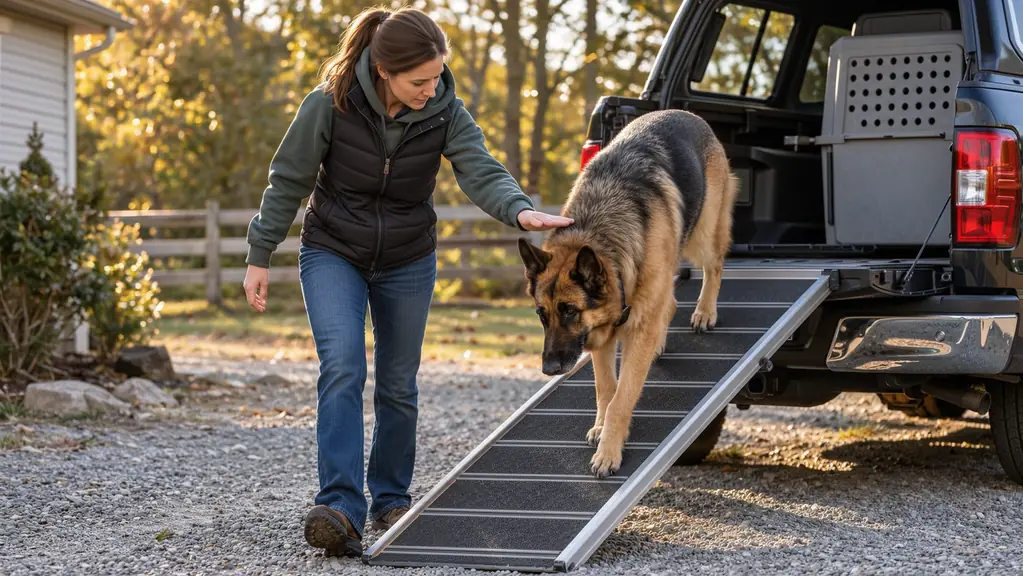
Now set it up the way you did in step one. Latched, feet flat, shallow angle, at the rear cab door. Moose rides in the back seat of the cab in my truck, so the height he has to clear is the door sill, not the bed. If your dog rides in the bed, the same setup applies, only the drop is taller and you will want the base pushed out further to keep the climb gentle.
Lay a treat trail. One at the bottom of the ramp, one about halfway, one at the top on the floor of the cab. Not a handful at the top, or he will rush the last third and catch a hind paw on the sill.
Where you stand matters as much as the angle. Stand at the side of the ramp near the top third with one flat hand at his shoulder. That hand is for steadying, not steering and not pushing. Never stand behind a dog on a ramp. If he stops halfway he cannot back down past your legs, and now you have a stuck eighty-pound dog in the air.
Our first real attempt was on a Saturday in March, and it went badly enough that I quit for the day. Moose got three paws up, stopped dead at the sill, and turned his head back over his shoulder to look at me. I did what I had been doing for a year without thinking about it. I put a hand under his chest and helped. He took the help, got in, and then would not touch the ramp for four days afterward. He had learned that stopping got him lifted. Once I quit helping entirely and just waited him out, the balking stopped inside a week. That is the single hardest habit to break with a big dog and a ramp, and it is entirely a habit in your hands, not his.
If he balks at the sill, do not lift him. Walk him off, reset, and put the top treat closer to the edge where he can reach it without stretching. The first time he gets all four feet up and into the cab, stop. Shut the door, drive to the park, and let that be the win for the day. Running him up five more times because it went well is how people turn a good first session into a dog who refuses the ramp by Thursday.
Step 5: Teach the Unload, Then Make It Boring
Coming down is scarier than going up, and it is the half most people forget to practice. A dog looking down a slope sees nothing but a drop. Give him a slow count and a hand at the shoulder and let him come down at whatever pace he sets. Do not hurry him with the leash.
Watch his feet on the way down. A dog with hip arthritis will often try to swing his back end around and come down sideways, which is a fall waiting to happen. If he does that, the angle is too steep. Reset the base further out and try again tomorrow.
I keep the PetSafe ramp folded against the same stud in the garage, latch side out, so I can grab it with one hand and have it open in about fifteen seconds. Same spot, same order, every trip. That sounds like fussiness. What it actually does is remove every small difference from one load to the next, and a dog that is unsure of his footing does better when nothing about the routine changes. If the ramp is leaning somewhere new every time, he has to re-decide whether it is safe, and some days he will decide it is not.
After about two weeks of treats on every load and unload, taper. Treat at the bottom, nothing at the top, then treat every other trip, then only at the destination. Moose now walks up because the ramp means the park, and the park beats a treat in the driveway every time.
Wipe the treads when the weather turns. A wet ramp in January is the one condition where I will lift him instead, back or no back.
What Else Helps
The ramp solves one problem, which is the height of the truck door. It does not solve the rest of it, and I would be lying if I said one piece of gear turned Moose around. The PetSafe ramp is the tool that gets him into the cab. Everything below is about the other twenty-three hours of his day.
The most useful thing my vet told me was to keep him lean. Every extra pound is load on a bad hip, and it is load he carries up a ramp too. That cost me nothing but a measuring cup and a little discipline about table scraps.
Inside the house the hardwood and tile were a separate problem. Moose wears non-slip socks on the slick floors in the evenings and on cold mornings. They twist and slide off now and then and I put them back on, and I take them off for outdoor walks. They are not a fix for the hips. They just cut down the slipping that makes a stiff dog worse.
He has been on a daily joint supplement since that age-eight checkup and he sleeps on an orthopedic bed in the living room corner. Neither one gets him into the truck, and neither one is a substitute for the ramp. They matter, just not at the door sill. Ask your vet what applies to your dog, because arthritis in a ten-year-old Lab and arthritis in a three-year-old shepherd are not the same conversation.
Set it at the door, latch it, and let him do the climbing
Sixty-two inches of run, 10 pounds to carry, 150 pounds of load rating, and four rubber feet that need level ground. That is the whole tool. The rest is a couple of weeks of treats and the discipline not to lift him.
Amazon Check Today's Price on Amazon →