
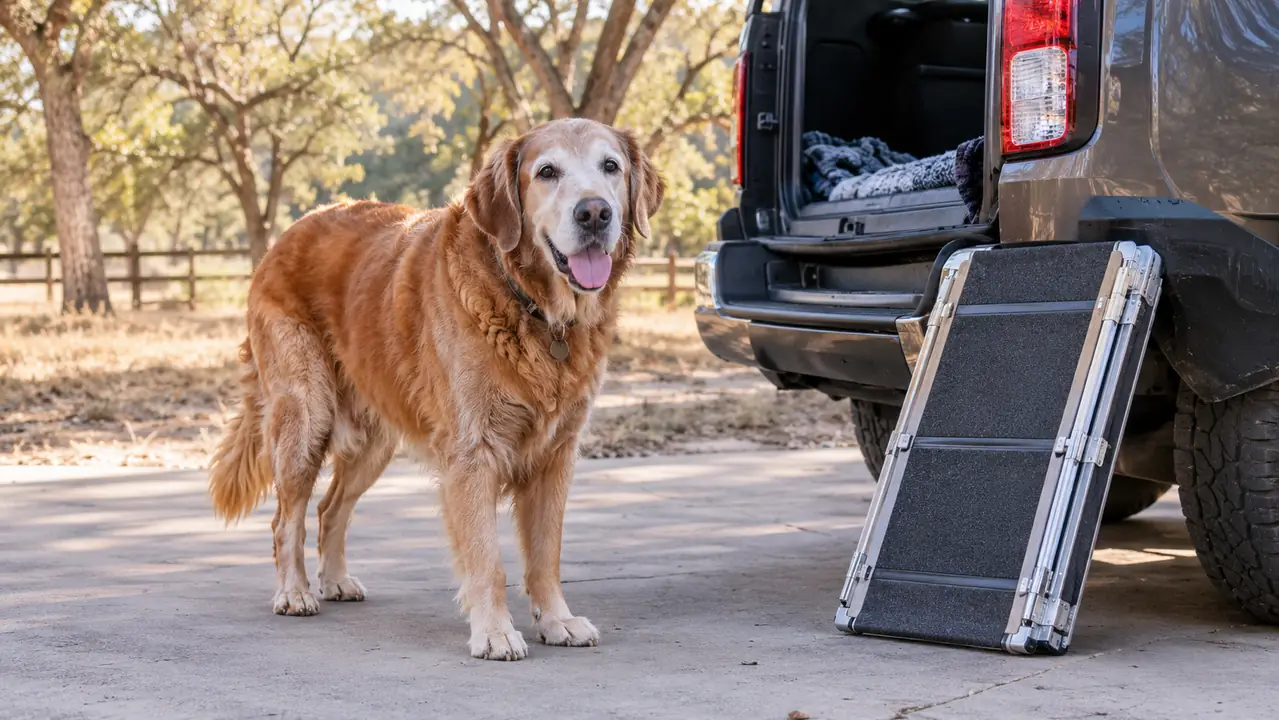
The ramp was not my idea. My back was. Somewhere around Moose's tenth year, lifting 82 pounds of Labrador into the back seat of a 2014 Ford F-150 stopped being a thing I could do casually, and started being a thing I had to think about before I did it. So I bought the PetSafe Happy Ride Folding Dog Ramp about eight months ago, and I have used it on every trip to the park, the vet, and the hardware store since.
This is the honest version of that eight months. Not the version where the senior dog trots up the ramp in the listing photo while violins play. The real version, which includes two weeks where Moose would not touch the thing, a rubber foot I had to hunt for in gravel, and a set of treads that need a brush more often than I expected. The ramp works. It just does not work the way the box implies, and the gap between those two things is what this review is about.
The Quick Verdict
A genuinely useful 10-pound ramp that solved a real problem for me, held up over eight months, and made my dog's truck trips his own again. It is not a walk-up-and-go product, and the folding hinge is the part I would watch.
Amazon Check Today's Price →If you are here because your dog has started hesitating at the tailgate, the short answer is that this ramp is worth owning for a large dog in a pickup or an SUV. If you are here because you want to know what you are actually signing up for, keep reading, because the training, the angle, and the surface matter more than the ramp itself.
The ramp that got an 82-pound Lab back into his own truck
Ten pounds, folds in half, rated to 150 pounds. It is the one I keep leaning against the garage wall.
Amazon Check Today's Price on Amazon →What Nobody Tells You Before You Buy
Here is the first thing. The PetSafe Happy Ride Folding Dog Ramp is 62 inches long. That is five feet and change, and when you unfold it against a truck, that length is doing the work. It is also the reason your first attempt will feel like you are building a wheelchair access ramp for a public library. There is a lot of ramp on the ground.
The second thing is that a ramp only helps if the dog agrees to it. My dog did not agree to it for two weeks. He stood at the bottom and looked at me like I had set a trap. And in a sense I had, because the surface was unfamiliar and the angle was wrong and the thing makes a low hollow sound when a paw lands on it.
The third thing, and the one that matters most for a big dog, is that this is a folding ramp. The hinge in the middle is what makes it portable and it is also the only part of the product I have any real reservation about after eight months. Everything else has held up. That hinge is what I check.
Here is the fourth thing, and it is the one I got wrong first. The PetSafe ramp is 16 inches wide. Moose is a broad-chested dog, and 16 inches is enough for him, but it is not generous. If your dog is wider than a Labrador or tends to drift, you will notice the side rails doing real work. The rails are low, just enough of a lip to feel a paw catch, and they are the difference between a dog correcting himself and a dog putting a back paw on air. I did not think about width at all before I bought it. I think about it now every time he loads.
How I've Used It, and Where It Lives
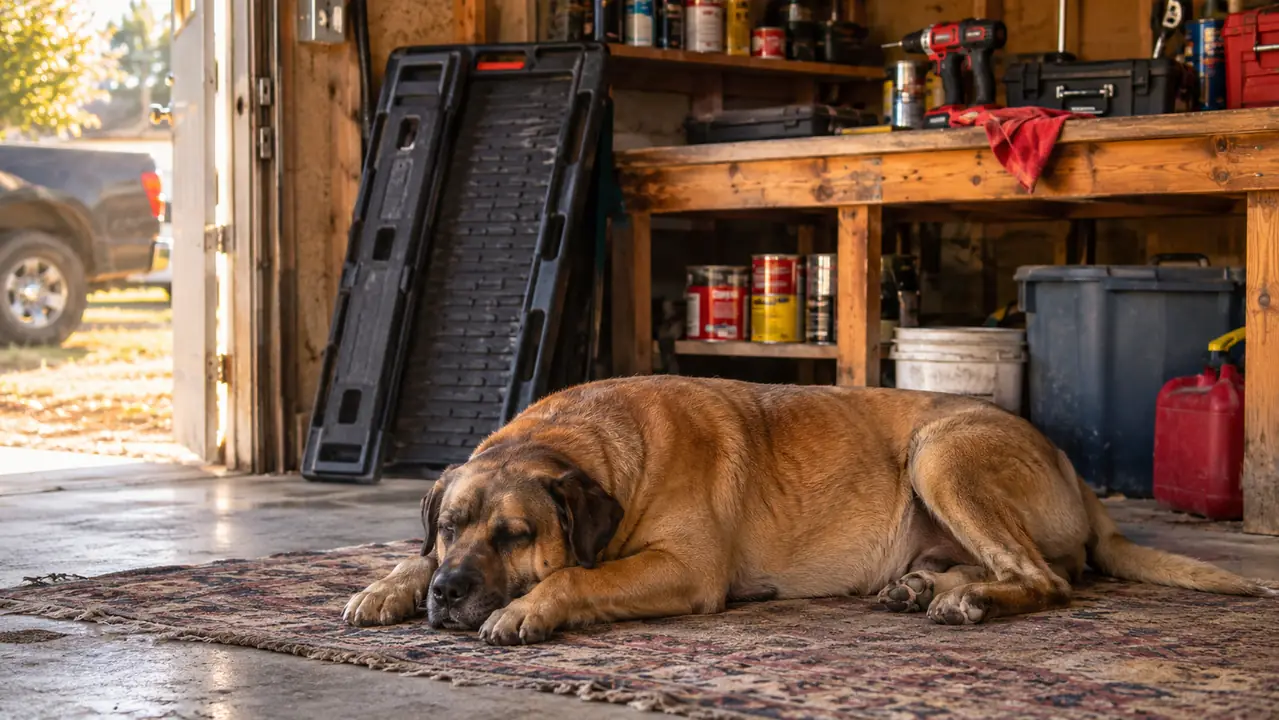
The ramp lives folded in the garage, leaning against the wall next to the workbench. It weighs 10 pounds, which means I can carry it out with one hand while holding Moose's collar with the other, and that mattered more than I expected. A heavier ramp would have stayed home on the days I was already running late.
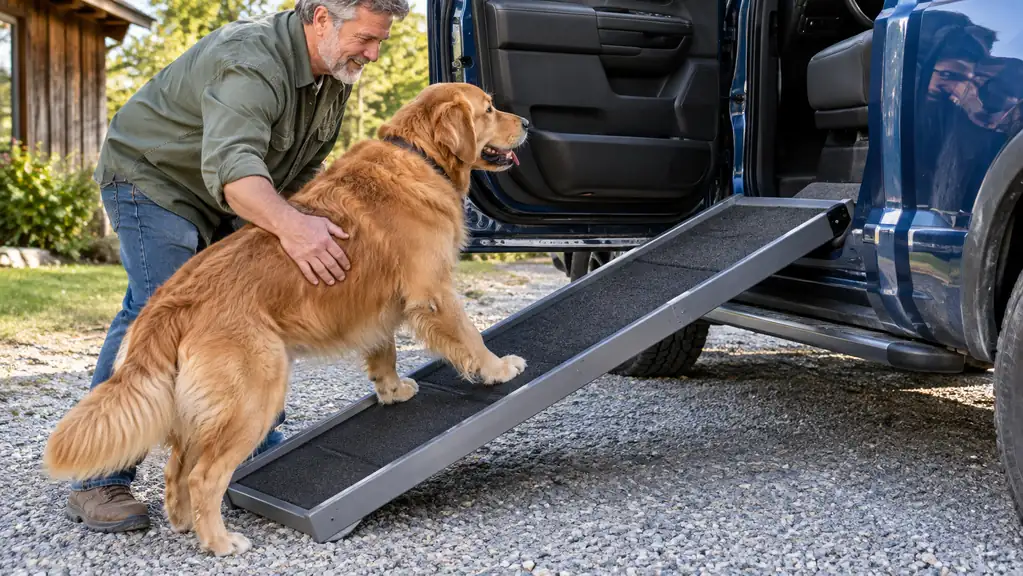
I set it against the rear cab door of the F-150. Not the tailgate. Moose has always ridden in the back seat of the cab, and the door opening is where he needs help, so that is where the ramp goes. It is rated to hold 150 pounds, which gives an 82-pound dog a comfortable margin, and the four rubber feet sit on my driveway without sliding. On gravel they sit slightly less well, and I have had to reposition the bottom end once or twice.
It has side rails, which sound like a small detail until you watch a stiff-hipped dog drift sideways halfway up. They keep a paw from sliding off the edge. The treads are high-traction, and in dry weather they are fine. In the rain, with wet paws, they are less fine, and I dry the ramp off with a rag before we load up.
The setup is the same every time. I pull the ramp out of the garage, unfold it on the driveway, and set the safety release latch. Then I set the top end on the door sill of the F-150's rear cab door and the bottom end on the concrete. The sill on my truck is high enough that a dog should not be jumping it, and with the ramp at 62 inches, the angle comes out shallow enough that Moose can walk it without bunching up his back legs. The first time I set it up, I left the bottom end on the gravel shoulder instead of the concrete, and the feet crept about an inch while he was on it. Now I clear a spot on the concrete first. It takes ten seconds and it is worth it. The latch is the only part of the setup that requires two hands, and it is also the part I check before I let the dog on. If it is not seated, the ramp is not ready.
The Two Weeks Where It Did Not Work
I want to be specific about this, because the reviews that skip it are the ones that made me buy the ramp expecting something else.
For the first two weeks, Moose would put one front paw on the ramp and then step back off. That is a training problem, not a product problem, but it is a real cost of ownership and nobody puts it on the box. What worked was treats, a lot of them, and putting a piece of kibble two inches up the ramp and letting him reach for it without any pressure. Then four inches. Then a foot. It took about ten days before he walked up the whole thing on his own, and another four before he stopped hesitating at the top.
About day six, he slipped. He got two paws up and one back paw caught the edge of the tread wrong, and he scrambled sideways and came off. He was fine, but he would not go near the ramp for two days after that. I went back to the beginning. I put the ramp flat on the garage floor, no height at all, and fed him his dinner kibble one piece at a time while he stood on it. Then I raised one end on a brick. Then two bricks. It was another week before we were back at the truck, and that week was the most important one in the whole process. If your dog slips once, do not rush him back. Make the ramp boring again before you make it tall.
The angle was the other half of it. My first setup had the ramp steeper than it needed to be because I had it propped on the truck's door sill instead of flat on the driveway. Flattening it out made the difference. A shallower angle is easier on a stiff back end, and the ramp is long enough to give you a shallow angle if you actually use that length instead of standing it up like a plank.
What worked was treats, a lot of them, and putting a piece of kibble two inches up the ramp and letting him reach for it without any pressure.
The Hinge, the Weight, and the Honest Downsides
The hinge is a folding joint in the middle of a 62-inch plastic ramp, and it does what folding joints do: it flexes slightly under load. Not enough to feel unsafe with an 82-pound dog, but enough that I notice it, and enough that I do not let Moose stand around at the top of the ramp while I find my keys. If you have a much heavier dog, closer to the 150-pound rating, I would want to see that flex myself before committing.
The material is plastic. That is what makes it 10 pounds, and it is also why I do not leave it out in the sun all summer or toss it in the bed of the truck loose with the shovels. It has held up over eight months with no cracks, and the manufacturer backs it with a one-year warranty, which is a modest number and worth knowing before you buy.
The treads collect dirt and dog hair. That is not a defect, it is just what a textured surface does, and a stiff brush every couple of weeks keeps them gripping. Set your expectations accordingly.
Every couple of weeks I open the ramp all the way and look at the hinge. I am looking for white stress marks in the plastic and for any play in the joint. Eight months in, there are no cracks and no white marks. There is a little side-to-side play when the ramp is open, maybe a quarter inch at the middle, and that is the thing I would keep an eye on if I had a heavier dog. The safety release latch has not loosened. When the ramp is folded, it is 4 inches thick, which is thin enough to slide behind the workbench or stand in the corner by the door. That folded profile is a big part of why this ramp actually gets used. A ramp that lives in the bed of the truck and gets rained on is a ramp that will not last. Mine lives indoors, and that is on purpose.
What I Liked
- Ten pounds, folds in half, carries with one hand
- 62 inches of length gives a genuinely shallow angle for a stiff dog
- Side rails and four rubber feet keep a large dog centered
- Rated to 150 pounds, comfortable margin for an 82-pound Lab
- High-traction treads work well in dry weather
- Made in the USA and backed by a one-year warranty
Where It Falls Short
- The mid-ramp hinge flexes slightly under a big dog
- Rubber feet shift on loose gravel
- Treads need regular brushing to keep their grip
- Wet paws and rain make the surface noticeably slicker
- Takes two weeks of treat training before most dogs trust it
- One-year warranty is short for the hinge, which is the wear part
How It Compares to the Alternatives I Looked At
I did not buy three ramps and test them side by side. I looked at what else was on the shelf and at a neighbor's setup, and I asked my vet what she sees people actually using. Here is the honest shape of that.
Dog steps are the obvious cheaper alternative, and they solve the same problem for a lower load height. They are also a stack of individual decisions for a dog with arthritis, because every step is a lift. A ramp turns five lifts into one continuous walk. For a stiff-hipped dog, fewer decisions is the whole point. Steps also take up more floor space in the garage and do not fold to 4 inches thick the way this does.
A lift harness is the other route, and I use one for the two back-porch steps on bad mornings. But a harness means you are doing the lifting, and the entire reason I bought a ramp was to stop doing the lifting into the truck. They solve different halves of the same problem. Neither one replaces the other for us.
A folding ramp is the only one of the three that lets an 82-pound dog load himself while I stand there with my hands in my pockets. That is the thing I was actually buying.
My neighbor has a set of plastic dog steps for his older shepherd. They are three steps, each about eight inches tall, and they work fine for his dog. I watched that dog go up them and I watched mine try them once. Moose put one front paw on the first step and then looked back at me. The difference is that steps ask the dog to make three separate decisions and a ramp asks for one continuous one. For a dog with hip arthritis, fewer decisions is the whole thing. My vet did not recommend a specific brand. She said the dogs she sees do best with a ramp that is long enough to be shallow and stable enough that the dog trusts it. That is the PetSafe ramp, and it is also several other ramps. The brand is not magic. The length and the stability are.
Who This Is For
This ramp is for the owner of a large or senior dog who has started hesitating at a tailgate, a truck cab, or an SUV hatch, and who is still physically able to fold and carry a 10-pound object. It suits a dog between roughly 50 and 140 pounds. It suits a pickup or SUV owner, because that is the load height the 62 inches is built for. And it suits someone willing to spend two weeks on treats and a shallow angle rather than expecting the dog to figure it out on day one.
If your dog is already at the point where he cannot bear weight on a hind leg, this is not the tool. That is a conversation with your vet, and probably a harness and a sling, not a ramp. The ramp is for a dog who can still walk but should not be jumping.
A friend of mine has a 9-year-old golden retriever that weighs about 70 pounds and rides in the back of a CR-V. She bought the same ramp after watching Moose use mine. Her dog took to it in three days, which I attribute to the dog and not to her training. Some dogs are just more willing. If yours is not, the two-week estimate is real and maybe optimistic. The ramp is the tool. The dog decides the timeline.
Who Should Skip It
Skip it if your dog is small enough to lift without thinking about your own back. A 20-pound dog does not need five feet of ramp, and a set of steps will do the job for a fraction of the garage space.
Skip it if you have a very heavy dog near the top of the weight rating and you want zero flex underfoot. Look at a rigid ramp instead, and check the hinge in person if you can.
And skip it if you are not going to train it. The ramp does not work on its own. If the plan is to set it down and hope, the dog will keep standing at the bottom looking at you, and the ramp will stay folded against the garage wall where mine would have stayed if I had given up in week one.
One more thing worth saying plainly: keep your dog lean and keep him moving. My vet told me that at Moose's age-8 checkup and it has done more for him than any single piece of equipment in this garage. The ramp solves the truck. It does not solve the arthritis.
Eight months, one hinge, and a dog who loads himself now
If your dog has started hesitating at the tailgate, this is the fix that worked here. Rated to 150 pounds, folds to 4 inches thick, carries with one hand.
Amazon Check Today's Price on Amazon →